
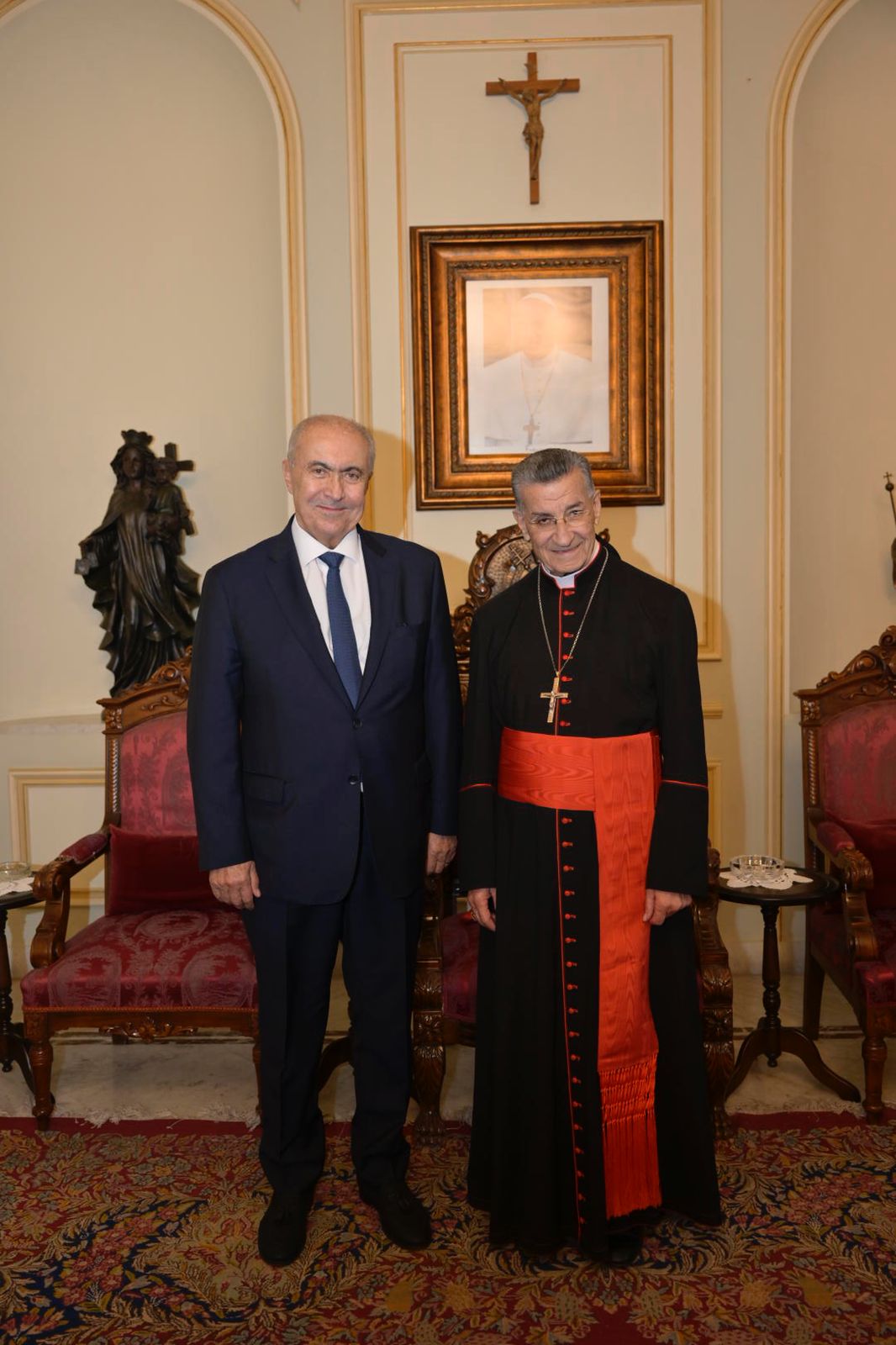
President of the National Dialogue Party, MP Fouad Makhzoumi, accompanied by political adviser Carol Zouein, visited the Maronite Patriarch, Cardinal Mar Bechara Boutros Al-Rai, at the Patriarchal See in Bkerke.
Following the meeting, Makhzoumi said that the visit was intended to discuss the latest developments in the war against Lebanon. He emphasized the importance of His Beatitude’s role, describing him as a national authority whose positions uphold national unity and the proper functioning of the state. While stressing the need to end the war, Makhzoumi affirmed that the first and most important step is to elect a President of the Republic, followed by the formation of a government that enjoys constitutional legitimacy and broad national representation. This would pave the way for the regular functioning of state institutions and the resumption of legislative activity in Parliament, enabling Lebanon to benefit from the conferences and summits convened in its support, most recently the Arab-Islamic Summit held in Riyadh.
Makhzoumi noted that these conferences and diplomatic initiatives demonstrate the commitment of the Kingdom of Saudi Arabia, all Arab and Islamic countries, and Lebanon’s friends around the world to helping the country and its people. He added that unless we begin by helping ourselves and our country from within and fulfilling our constitutional obligations first, Lebanon will receive neither assistance nor support for reconstruction.
Makhzoumi also discussed the displacement crisis with His Beatitude and how it could be managed in a way that supports people who have been forced to leave their towns, land, and homes, as well as the residents of the areas hosting them, while safeguarding the local environment, social fabric, and civil peace. Makhzoumi questioned the government about the mechanism for distributing aid, asking whether it was actually reaching those who genuinely needed it through reliable and trusted channels.
In the same context, Makhzoumi addressed the proposal to keep displaced persons in Beirut’s public schools while transferring the students enrolled in those schools to other schools outside their areas. He categorically rejected this proposal, arguing that it effectively amounts to a plan to displace students from Beirut, echoing the scenario that occurred in the 1990s, when Beirut residents were forced to leave their capital for other areas.