
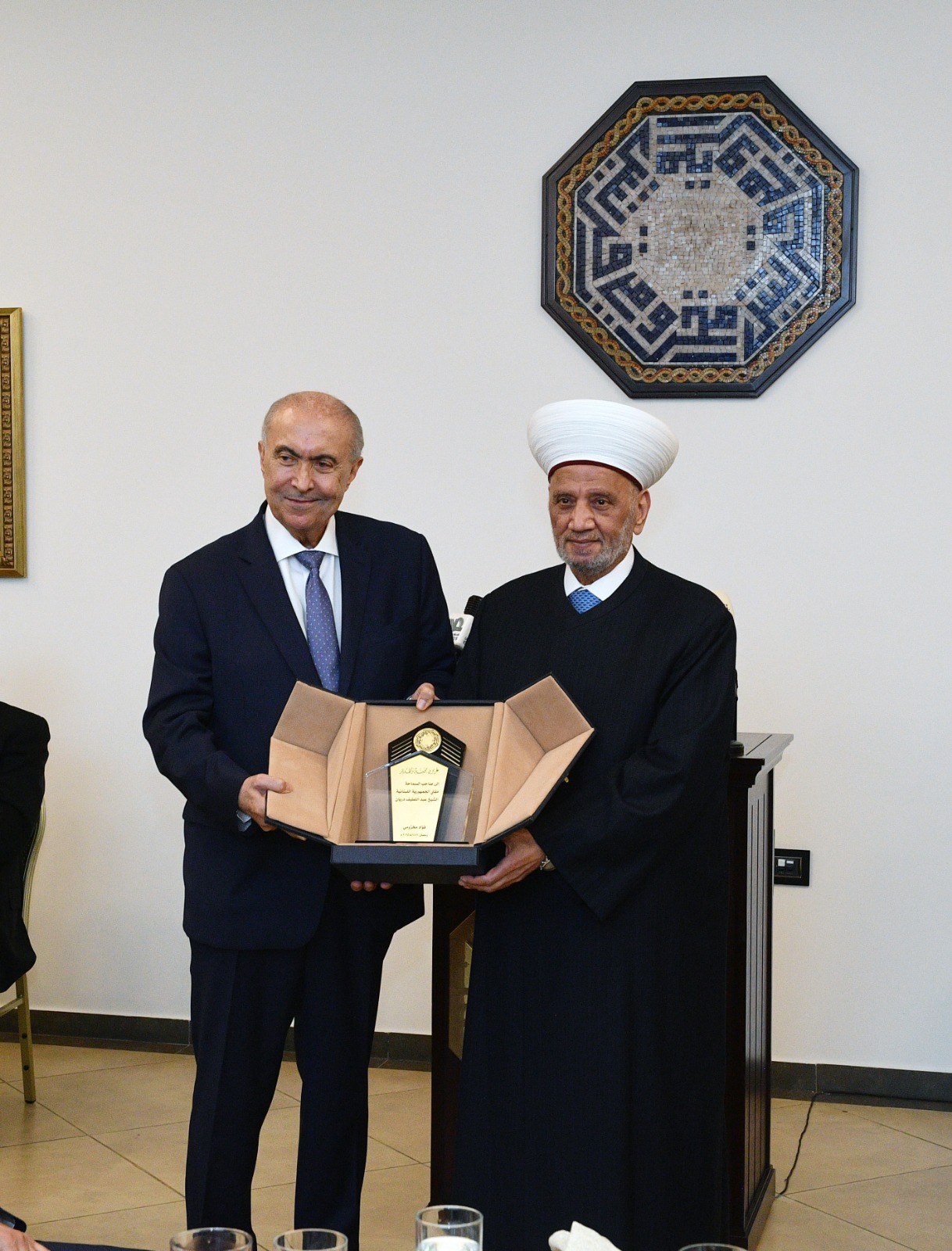
President of the National Dialogue Party and MP Fouad Makhzoumi and his wife, Ms. May, hosted a Ramadan iftar at their residence in honor of His Eminence Grand Mufti Sheikh Abdul Latif Derian. The event was attended by Saudi Ambassador to Lebanon Walid Bukhari, Jordanian Ambassador Walid Al-Hadid, Egyptian Ambassador Alaa Moussa, Algerian Ambassador Kamal Bouchama, Tunisian Ambassador Bouraoui Imam, Moroccan Ambassador Mohamed Akrine, as well as a number of current and former MPs and ministers, religious leaders and dignitaries, heads of associations, prominent figures, and media representatives.
Welcoming the guests and His Eminence the Grand Mufti, Makhzoumi reaffirmed his support for the Mufti in continuing to uphold the message of moderation, maintain a firm stance, and preserve coexistence. He said that Lebanon was going through a difficult and painful transitional phase, following the devastating Israeli war that our people had endured and against which we had repeatedly warned. He stressed that, despite everything that had happened, what had helped heal the wounds was the country’s gradual recovery and the revival of the state from beneath the rubble.
Makhzoumi underscored the importance of reconciliation, but said that it must first be preceded by frankness and a willingness to confront the facts. There can be no reconstruction unless the conditions necessary for building a functioning state are met. He stressed that the state must reassert its authority throughout its territory through its legitimate forces alone, implement the Constitution and the Taif Agreement, which provides for the disarmament of militias, and uphold the ceasefire agreement, UN Security Council Resolutions 1559, 1680, and 1701, and the Armistice Agreement. These steps are essential to securing continued international support and safeguarding Lebanon and its sovereignty.
Makhzoumi added: “Today, we have a President of the Republic who began his term with a visit to the Kingdom of Saudi Arabia.” He said the visit signaled Lebanon’s return to the Arab fold, highlighting the Kingdom’s values of brotherhood, cooperation, and commitment to Lebanon. Saudi Arabia, he noted, had consistently supported Lebanon and its people, particularly through its active participation in the Quintet Committee. Makhzoumi thanked the Kingdom and its leadership, the United States, France, Egypt, and Qatar for their efforts to help Lebanon emerge from its crisis.
He continued: “The state has begun to reclaim its role, and a government has been formed, with all of us contributing to its establishment after deciding to set aside calculations that have no place in this process.” He noted that the government now faced numerous responsibilities, beginning with reopening all investigations into the large-scale embezzlement and theft that led to the economic collapse in 2019. These include conducting a forensic audit of Banque du Liban and the Ministry of Finance, investigating the issue of bank deposits and the banking sector, determining responsibility for the loss of Lebanese citizens’ and depositors’ savings, and conducting forensic investigations across all ministries to establish accountability and prosecute figures involved in corruption and the promotion of corrupt practices. He concluded that a law guaranteeing judicial independence must be passed so that the judiciary would be equipped to handle these cases and ensure accountability.
Makhzoumi also addressed two messages, one to Palestine and the other to Syria. He expressed his hope that Palestine would achieve a just and comprehensive peace based on the two-state solution endorsed at the 2002 Beirut Summit. He also called for correcting relations between Lebanon and Syria on the basis of mutual respect for both countries’ sovereignty, accelerating the return of displaced Syrians, beginning the complete demarcation and securing of the land border, and demarcating the maritime border.
Regarding the municipal elections in the capital, Makhzoumi said he looked forward to the election of a competent municipal council free from political polarization, one capable of advancing Beirut’s development, in contrast to the previous period, which was marked by mismanagement and failure to meet the capital’s development needs.
He concluded by emphasizing that electing a sovereign and reform-oriented Parliament in the 2026 elections, through the people’s votes and determination, would mark the serious beginning of restoring Lebanon to the position it deserves.
Following Makhzoumi’s address, the Grand Mufti was honored in recognition of his national and religious role.
In his remarks, Grand Mufti Sheikh Abdul Latif Derian thanked Makhzoumi for hosting and honoring him, saying that Beirut’s representative was making every effort to help people and stand alongside his fellow citizens in the capital. He stressed the importance of upholding the Constitution and the Taif Agreement as enduring points of reference for Lebanon, warning against any attempts to circumvent them and the internal and external conflicts such actions could trigger.
Regarding the government, Mufti Derian affirmed his support for it, while emphasizing that this support came with expectations and close attention to the urgent measures it would take. He noted that reservations expressed by some parties, whatever their reasons, should not prevent the government from being given an opportunity to deliver on the aspirations of the Lebanese people. He expressed cautious optimism about the domestic situation while criticizing those whose loyalties were tied to foreign agendas. “When all Lebanese return to their Lebanese identity, and all political parties return to their Lebanese identity, we will have a normal government and opposition working for the good of the nation,” he said.
The Mufti noted that the holy month of Ramadan inspires hope for a better future, something everyone in Lebanon and the wider Arab region aspires to. He drew attention to Palestine and Al-Aqsa Mosque, pointing out that famine continued in Gaza during this blessed month and asking what Muslims and Arabs would do in response. He stressed that Lebanon and the Palestinians faced a ruthless enemy and described the conflict as one with deep historical and religious roots. He called for continued solidarity with the Palestinian people in their struggle, affirming that support for Palestine would continue until a Palestinian state was established with East Jerusalem as its capital.
On Syria, the Mufti affirmed his support for the new Syrian state, emphasizing that Lebanon had always supported the choices of the Syrian people. He called for respect for Syria’s sovereignty and stability. He also noted that Dar Al-Fatwa and the Lebanese people stood alongside displaced Syrians who continued to live in Lebanon, rejecting any mistreatment or attacks against them, including the burning of their tents or similar acts.
In his address, the Mufti also highlighted the importance of Tripoli and northern Lebanon, stressing that the region was an integral part of the country. He said Tripoli was not a city of terrorism, but rather a city of knowledge, patriotism, and Arab identity, which had always been a safe city welcoming all Lebanese. He called for strengthening security and stability in the city and warned against attempts to tarnish its reputation. He stressed that the state must take firm measures against anyone seeking to undermine the city’s security.
The Mufti concluded by calling for national solidarity, warning that any deviation from an inclusive national path would plunge Lebanon back into a cycle of chaos and instability. He urged everyone to place the national interest above narrow factional interests.
Finally, Makhzoumi invited the attendees to join him for the iftar meal.