
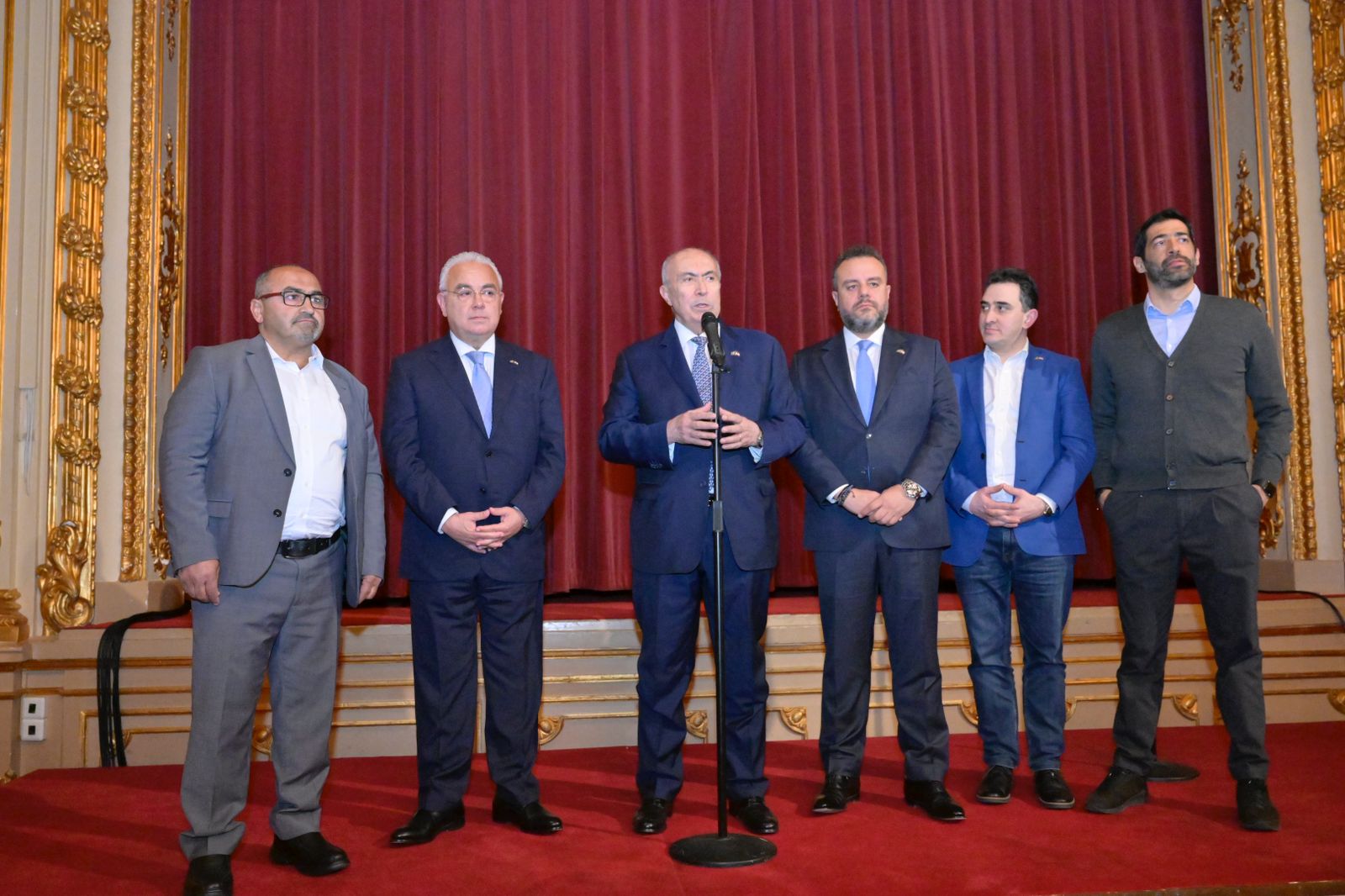
At the invitation of the Swedish government, which currently holds the rotating presidency of the European Union, and at the initiative of MP Fouad Makhzoumi, a parliamentary delegation visited Stockholm. The delegation included MPs Fouad Makhzoumi, Razi Al-Hajj, Bilal Al-Hashimi, Adib Abdel Massih, Elias Hankash, and Ghassan Skaf, as well as Ms. Carol Zouein, MP Makhzoumi’s Political Advisor; Dr. Henri Chaoul, Financial and Economic Advisor; and Mr. Joseph Hayek, representing the Swedish Embassy in Lebanon. The visit aimed to brief European officials on Lebanon’s current crisis and follow up on economic issues, foremost among them an agreement with the International Monetary Fund (IMF).
The delegation began its visit by meeting with the Lebanese community in Sweden. It subsequently met with Ulrika Sandberg, Sweden’s Special Envoy to the Organization of Islamic Cooperation and for Intercultural and Interreligious Dialogue; Dag Juhlin-Dannfelt, Director-General for Political Affairs at the Swedish Ministry of Foreign Affairs; Eva Sjögren, Director-General for European Union Affairs; Line Wikström Rosvall, Senior Advisor and Deputy Head of the International Financial Institutions Unit; and Ingvar Mattson, Secretary-General of the Swedish Parliament.
The delegation also met with the Swedish Parliament’s Committee on EU Affairs and Committee on the Constitution, as well as members of its Committee on Finance, Committee on the Labour Market, and Committee on Social Insurance.
MP Makhzoumi stressed that this initiative was the least that could be done for Lebanon, adding that further initiatives would follow. He emphasized that it was our duty to convey an accurate picture of the situation in the country and the hardships facing the Lebanese people to the international community, so that the world would understand that a sovereign political group operating outside the corrupt establishment is seeking change and is committed to implementing reforms.
He thanked the Swedish government and Sweden’s Ambassador to Lebanon, Ann Dismorr, for her efforts to ensure the success of the visit. He noted that the delegation had chosen to begin in Sweden because of its presidency of the European Union, highlighting the Swedish government’s considerable interest in Lebanon.
During his meetings, Makhzoumi emphasized Saudi Arabia’s significant role in supporting Lebanon. He noted that the Kingdom had consistently supported Lebanon and, over the past year, had provided it with five diplomatic frameworks of support: beginning with the Jeddah Declaration, followed by the Gulf initiative, the New York meeting, the joint Saudi-Egyptian statement, and finally the joint Saudi-Qatari statement. He stressed that these frameworks constitute an international safety net for Lebanon and a roadmap for rescuing the country from its crises.
Makhzoumi reiterated the importance of reaching an agreement with the IMF, describing it as an essential prerequisite for implementing reforms and the only way to restore the international community’s confidence in Lebanon and rebuild its relations with Saudi Arabia and the Gulf states.
He also stressed that state institutions cannot function properly until a sovereign president capable of leading Lebanon toward recovery is elected from outside the corrupt establishment, free from financial or political corruption and unconnected to anyone implicated in corruption. The president, he added, must have a clear and effective reform programme. Makhzoumi further emphasized the need for an independent judiciary.