
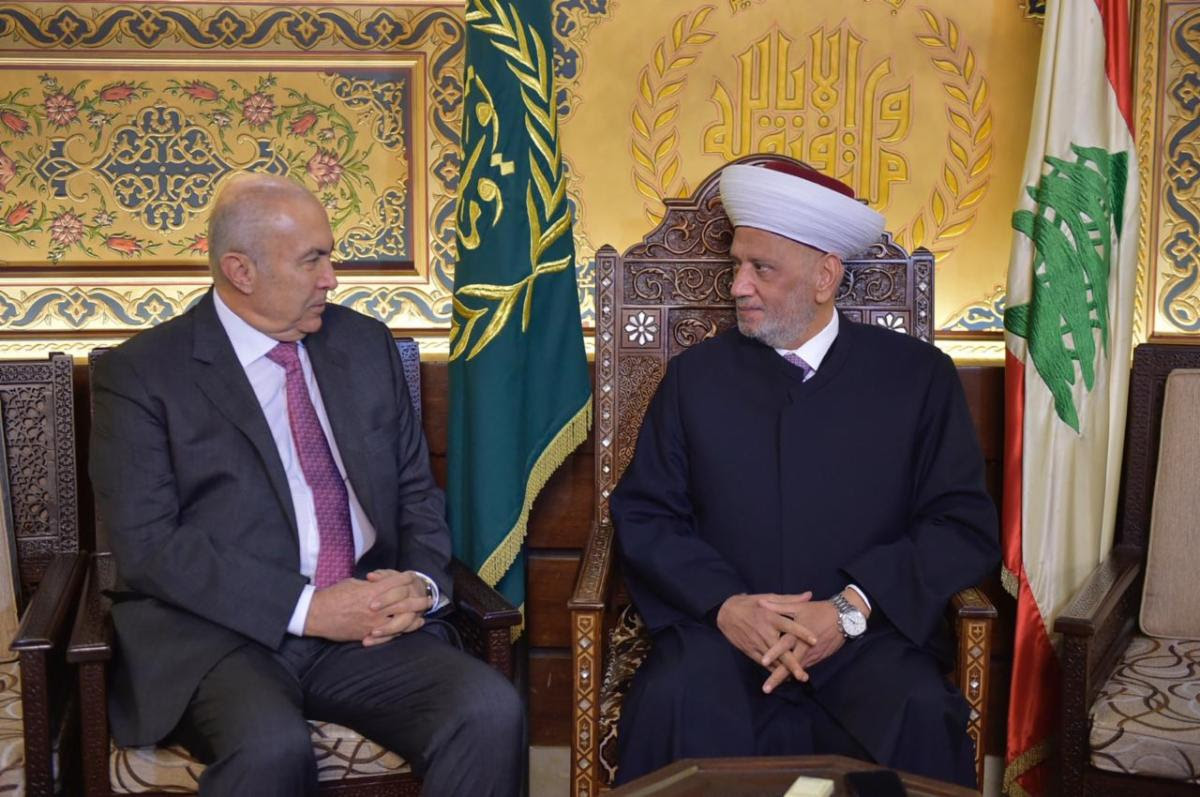
President of the National Dialogue Party, MP Fouad Makhzoumi, visited the Grand Mufti of the Republic, His Eminence Sheikh Abdul Latif Derian, at Dar al-Fatwa. They discussed matters concerning the institution and the general situation in the country.
Following the meeting, Makhzoumi said that the country was at a crossroads and that Dar al-Fatwa would remain a refuge for unity, continuing its role as a guardian of national unity and civil peace, in addition to its important role in managing the religious and social affairs of the community.
Makhzoumi renewed his condemnation of the banks’ practices of preventing citizens from withdrawing their salaries and life savings, particularly given that 86% of depositors are ordinary citizens. He described this as a crime, pointing out that banks were doing so to protect the profits they had made through financial engineering schemes. He noted that the same system was re-emerging, with a political class protecting banks that have a partnership with the Central Bank.
Addressing the government and the Governor of the Central Bank of Lebanon, he asked: “By what right are you taking money from citizens’ deposits to repay Treasury bonds when you know perfectly well which officials own them, thereby preventing citizens from benefiting from their own money?”
He stressed that the banks and the Central Bank’s financial engineering schemes bore responsibility for the security and social consequences of the ongoing violations of citizens’ most basic rights. He said the banks were responsible for the deterioration of the financial situation and for pushing more Lebanese people into poverty, and that they must be held accountable.
He said: “Everyone knows that banks subscribe to Treasury bonds representing approximately 10% of the public debt owed to foreign entities. When they noticed a shortage of liquidity, they decided to sell and exchange their own Treasury bonds with American banks, which are forcing the government to draw on the Central Bank’s reserves to meet its payment obligations and threatening it if it fails to pay or delays payment.”
He stressed that the government should have factored Lebanon’s obligations arising from sovereign bonds into its calculations and restructured these debts, rather than withdrawing the remaining dollars from the banking system, particularly from citizens’ deposits.
Makhzoumi continued: “Despite some reservations about the new government, it does include new faces with specialized expertise.” However, he pointed out that its first major challenge was the Eurobond obligations.
He questioned what the Central Bank would do to secure dollars for wheat, milk, fuel, and medicine if its dollar reserves ran out, given that priority was being given to repaying Eurobonds amounting to approximately $1.2 billion in March, $700 million in April, and $600 million in June. This, he said, would leave the Central Bank with only $5.7 billion in reserves to cover these and other essential commodities.
He therefore considered this a continuation of the economic policies pursued under previous governments, which, he said, did not bode well. He called on major banks to sell their overseas assets and real estate, restore public confidence, and take responsibility, warning that otherwise, the resulting devastation would affect everyone.
He added: “We were told that this government had a rescue plan. Where is that plan? What we have read so far in the ministerial statement reflects a continuation of the approach adopted by previous governments across all sectors, particularly since the government is relying on Parliament to pass laws that protect the system of corruption.”
He continued: “We hope there will be a clear vision that enables us to work together, because the current situation suggests that we are heading toward even worse conditions. This kind of financial mismanagement, which we have witnessed for 20 years, harms ordinary citizens, while the wealthy continue to protect themselves and the banks conceal their profits, particularly given the partnership between the corrupt political class, the banks, and the Central Bank.”