
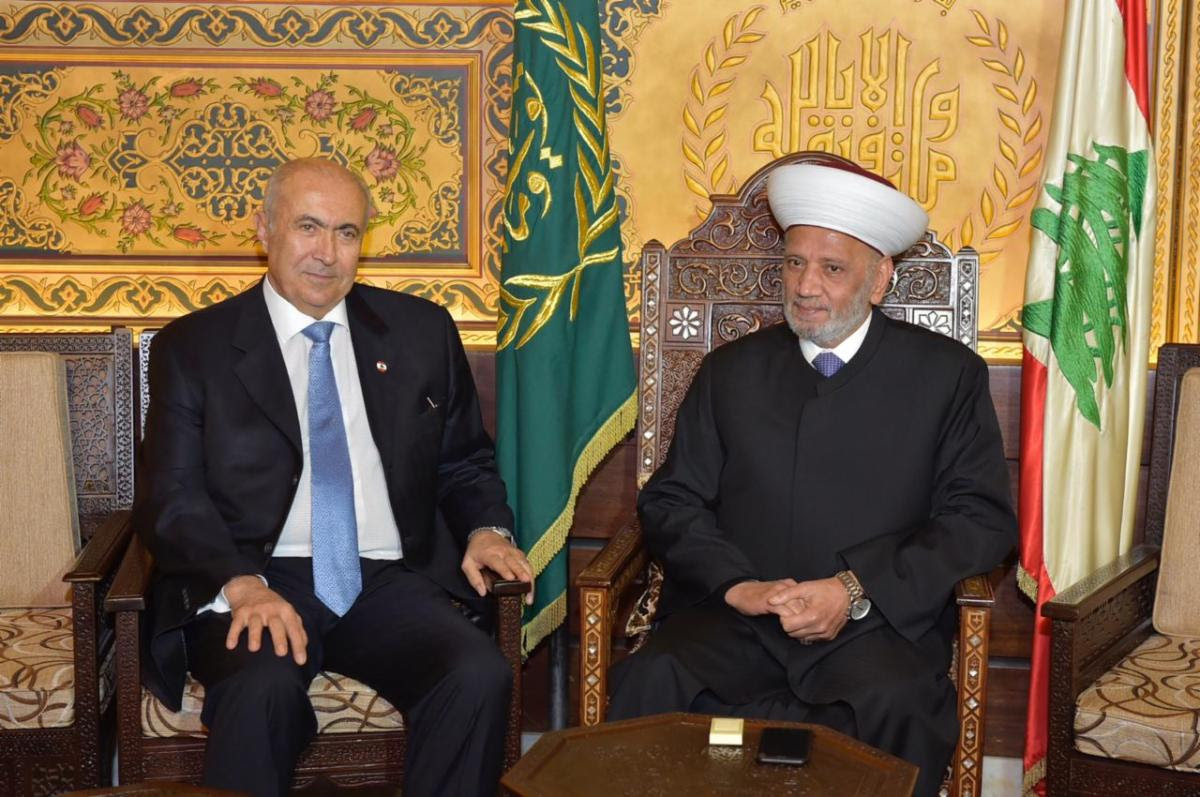
President of the National Dialogue Party, MP Fouad Makhzoumi, accompanied by Political Bureau member Samer Safah, visited the Grand Mufti of the Republic, His Eminence Sheikh Abdul Latif Derian, at Dar al-Fatwa. They discussed matters concerning the institution and the general situation in the country.
Following the meeting, Makhzoumi said: “Our meeting with His Eminence came at a very important time, amid the ongoing debate over binding parliamentary consultations and statements being issued and attributed to Dar al-Fatwa and the Grand Mufti.”
He added that the Grand Mufti had emphasized that Dar al-Fatwa was a national religious authority and a home that embraced all Lebanese, particularly members of the Sunni community. He had also stressed that binding parliamentary consultations would determine the identity of the candidate for prime minister, and that Dar al-Fatwa’s doors were open to anyone appointed to the position, as all members of the Sunni community belonged to this institution.
“This is the strategic relationship we have always known between Dar al-Fatwa and Parliament,” Makhzoumi said, expressing hope that the consultations would take place as scheduled the following day at Baabda Palace.
He continued: “We will no longer accept statements being attributed to Dar al-Fatwa and the Grand Mufti. His position was clear and explicit: he is a father to all members of the Sunni community and has no preferred choice regarding the appointment of a prime minister. Dar al-Fatwa does not vote in Parliament; rather, it is a national religious authority whose sole concern is to ensure consensus over the appointment and that Parliament fulfils the role for which it was elected.”
Makhzoumi stressed that the country was facing a severe economic situation that could not afford the luxury of waiting, particularly amid the shortage of US dollars. He said some political forces were still engaging in political maneuvering under the slogan, “Either us or chaos,” while stirring sectarian and denominational tensions, as was currently being witnessed in the streets.
“This game has been exposed before the Lebanese people and the world,” he said, praising the protesters for responding to these developments rationally and thoughtfully. He noted that political realignment was underway and represented a particularly important strategy at this stage, especially given regional messages urging Lebanon to form a short-term government of specialists from outside the political establishment. Such a government, he said, should close the channels through which public funds were wasted, fight corruption, and recover stolen funds in order to secure financial support.
As evidence, he pointed to Saudi Arabia’s absence from the International Support Group for Lebanon conference recently held in Paris.
Makhzoumi continued: “Regardless of the discussion about possible interference in Lebanon’s affairs, we have sensed an awakening among several political forces through their statements acknowledging that the situation cannot continue as it is and that change has become absolutely necessary. The people in the squares reject the return of any figures from the political establishment to power.”
He warned that bringing the same political establishment, or even part of it, back to power would mean that Lebanon did not need international support, which he said was plainly untrue. Given the country’s deteriorating economic conditions, he cautioned that Lebanon would face ruin if the international community abandoned it.
The Campaign Against Dar al-Fatwa
Asked whether he was defending Dar al-Fatwa amid the campaign against it, Makhzoumi said his relationship with the institution went back many years, as did his relationship with the Grand Mufti, which predated the latter’s election to the position.
“I believe His Eminence has been clear and frank,” he said. “During the 2018 parliamentary elections, he openly told me that he would support President Saad Hariri. The Mufti has no problem taking a public position.”
Makhzoumi added that reports attributing support for a particular candidate in the prime ministerial appointment process to the Grand Mufti were inaccurate. He stressed that he was not seeking to defend Dar al-Fatwa, as the Grand Mufti was capable of defending himself.
Samir Khatib and the Prime Ministerial Nomination
Regarding engineer Samir Khatib, Makhzoumi said he had been handled improperly and that his candidacy had been undermined. He added that Khatib did not deserve what had happened to him.
Asked whether he was a candidate for the new government’s premiership, Makhzoumi said he was not a candidate, but had an economic rescue plan. He added that he would support anyone who had a credible economic vision capable of rescuing the country.
He described the economic situation as dire and deteriorating, adding that the slogan “Either me or no one,” used by some political figures, served no purpose.
Makhzoumi noted that the only name being put forward was that of President Saad Hariri, whom he would not nominate. He also said he was unwilling to nominate anyone who had been part of the ruling establishment since the 1990s.
He expressed hope that the country would move beyond debates over names and focus instead on adopting economic rescue plans, regardless of who was appointed to implement them. He stressed that the old political establishment was responsible for bringing the country to ruin.
Contacts with Hezbollah and the Amal Movement
Asked whether he had been in contact with the Shiite duo—Hezbollah and the Amal Movement—to secure their support for him as a consensus candidate to lead a transitional government, Makhzoumi said that communication with all parties took place within Parliament.
He added that reports circulating at the time indicated that Hezbollah and Amal’s preferred choice was President Hariri.
Makhzoumi reiterated that he would nominate anyone who achieved consensus, provided that the person did not belong to the corrupt political establishment. He expressed hope that the parliamentary consultations would take place as scheduled, while voicing concern that they might be postponed.