
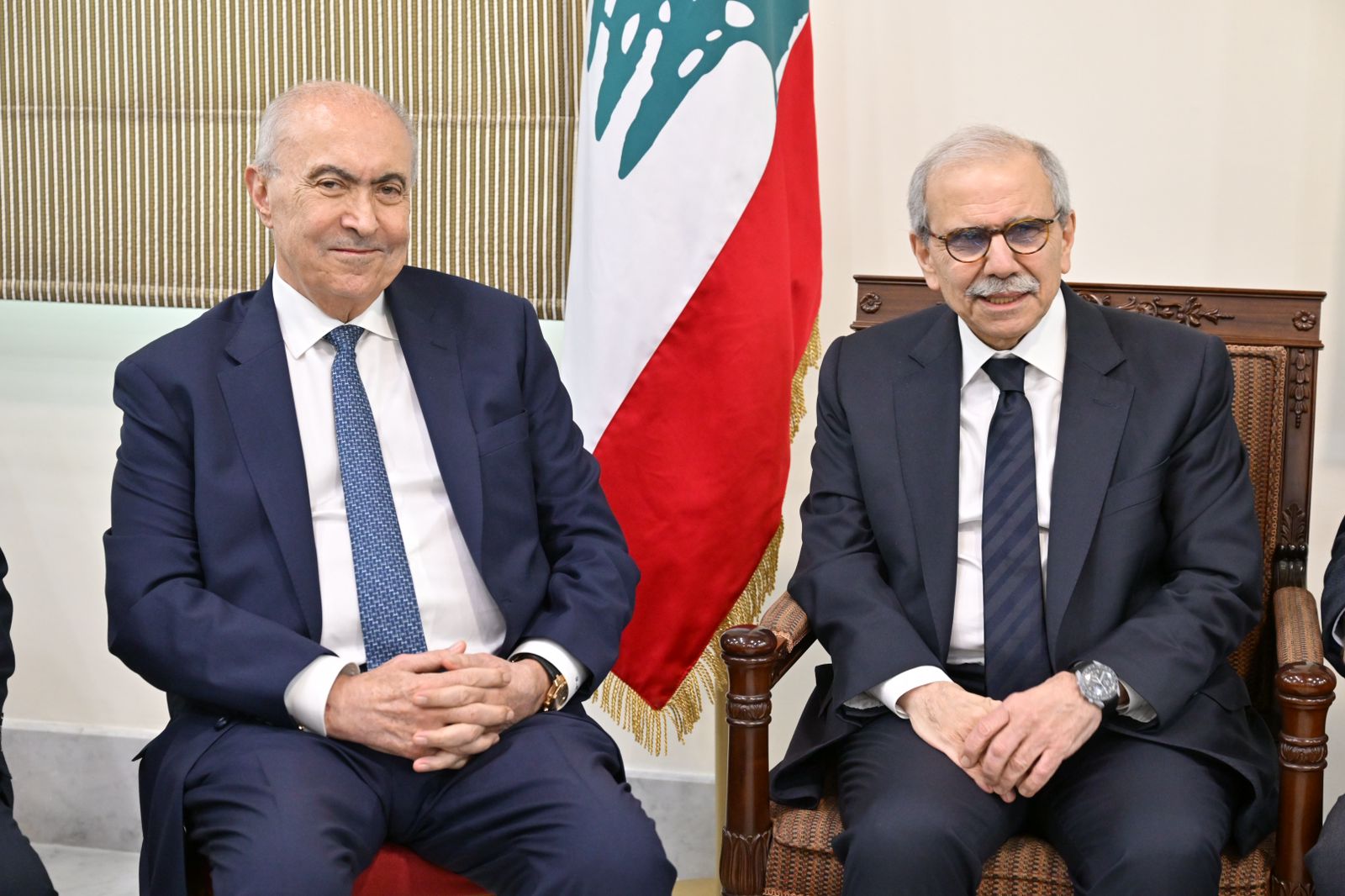
MP Fouad Makhzoumi, accompanied by delegations from the Beirut Dialogue Forum and the Beirut Gathering, visited Prime Minister Judge Nawaf Salam at the Grand Serail.
Following the meeting, Makhzoumi praised the Prime Minister’s openness and willingness to listen, emphasizing the importance of this approach at this critical juncture. He also congratulated him on the position adopted by the government during the latest United Nations Security Council session, describing it as a reflection of Lebanon’s supreme national interests and the sense of national responsibility required at this time.
Makhzoumi affirmed his support for the government’s reform agenda and the decisions it has taken, stressing that the current phase requires an immediate transition from decision-making to implementation, without delay, as Lebanon can no longer afford further procrastination. He emphasized that Lebanon stands at a critical and decisive crossroads, with its sovereignty under threat, its security violated, and the dignity of its citizens at stake. This, he said, demands a clear national approach, a shared sense of responsibility, and decisive action.
Makhzoumi stated that he had presented an integrated vision for restoring state authority and protecting Lebanon, founded on firm principles of sovereignty, outlined as follows:
First: Decisions on War and Peace Must Rest with the State
Makhzoumi stressed that the situation Lebanon is experiencing is not the result of a decision taken by the state, but rather of a reality imposed by the presence of weapons outside its authority. He argued that allowing this situation to persist undermines national decision-making and draws Lebanon into conflicts that do not serve its interests.
He affirmed that placing decisions on war and peace exclusively in the hands of the state is the fundamental starting point for restoring sovereignty. He renewed his call for the full implementation of international resolutions, beginning with the Taif Agreement and including United Nations Security Council Resolutions 1559 and 1701, without selectivity or delay.
He also stressed the need to implement the decision to ban Hezbollah, adopted on March 2, calling for a comprehensive ban on the party in all its political, military, financial, and security dimensions. He described it as a single, integrated entity that cannot be divided into separate components, considering such a ban a fundamental step toward restoring the state’s decision-making authority and full sovereignty.
Second: Beirut Security Plan — A Beirut Free of Weapons
Makhzoumi emphasized that the Beirut Security Plan is an urgent national priority aimed at establishing the capital as a city free of weapons.
He stressed the need for the comprehensive deployment of the Lebanese Army throughout administrative Beirut and extending to Greater Beirut, reinforced security measures through fixed and mobile checkpoints, and the full extension of state authority without exception. He also called for strict security coordination mechanisms to prevent any breach, protect civilians, shield the capital from potential attacks, and place Beirut exclusively under state authority.
Third: Full Sovereignty and an End to Foreign Interference
Makhzoumi stated that no state can function without full and undiminished sovereignty. He considered any refusal to implement Lebanon’s sovereign decisions concerning diplomatic affairs a clear violation of the 1961 Vienna Convention on Diplomatic Relations.
He noted that, under Article 9 of the Convention, Lebanon retains the full right to withdraw its acceptance of any diplomat and take whatever measures it deems appropriate, including reviewing its entire diplomatic representation when necessary.
He stressed that the Iranian ambassador’s refusal to comply with the Lebanese government’s decision requiring him to leave Lebanese territory within the specified deadline constitutes a flagrant violation of state sovereignty and a direct challenge to its authority. He said this requires a decisive sovereign response in the form of severing diplomatic relations with Iran without delay.
Makhzoumi also underscored the need for an immediate and transparent investigation into any information concerning foreign nationals entering Lebanon illegally, including through the use of forged documents or passports. He called for the prosecution and trial of anyone proven to have been involved in, or complicit in, actions that threaten Lebanon’s security and sovereignty.
Fourth: Choosing Stability — A Clear Political Path
Makhzoumi affirmed that Lebanon’s stability requires a clear political vision capable of ending the ongoing cycle of attrition. He called for direct negotiations with Israel to safeguard Lebanon’s supreme national interests and put an end to recurring cycles of war.
He stressed that these negotiations should be conducted through a minister duly authorized by the government, on the basis of a clear national agenda and a precise official mandate, ensuring the protection of Lebanon’s sovereignty and all its rights.
Fifth: Managing the Displacement Crisis with National Fairness
Makhzoumi expressed full solidarity with displaced people within a framework that preserves national balance. He stressed the need to respect private property, maintain public order, and safeguard the dignity of Beirut’s residents.
He called for the crisis to be addressed through a fair national plan that does not place the burden solely on the capital.
Makhzoumi concluded by emphasizing that the challenge facing Lebanon today goes beyond a political dispute; it is a national turning point that will determine the country’s future. Lebanon must either restore a sovereign, free, and independent state or continue paying the price for the conflicts of others.
He reaffirmed that the solution lies in one state, one decision, and one set of arms.