
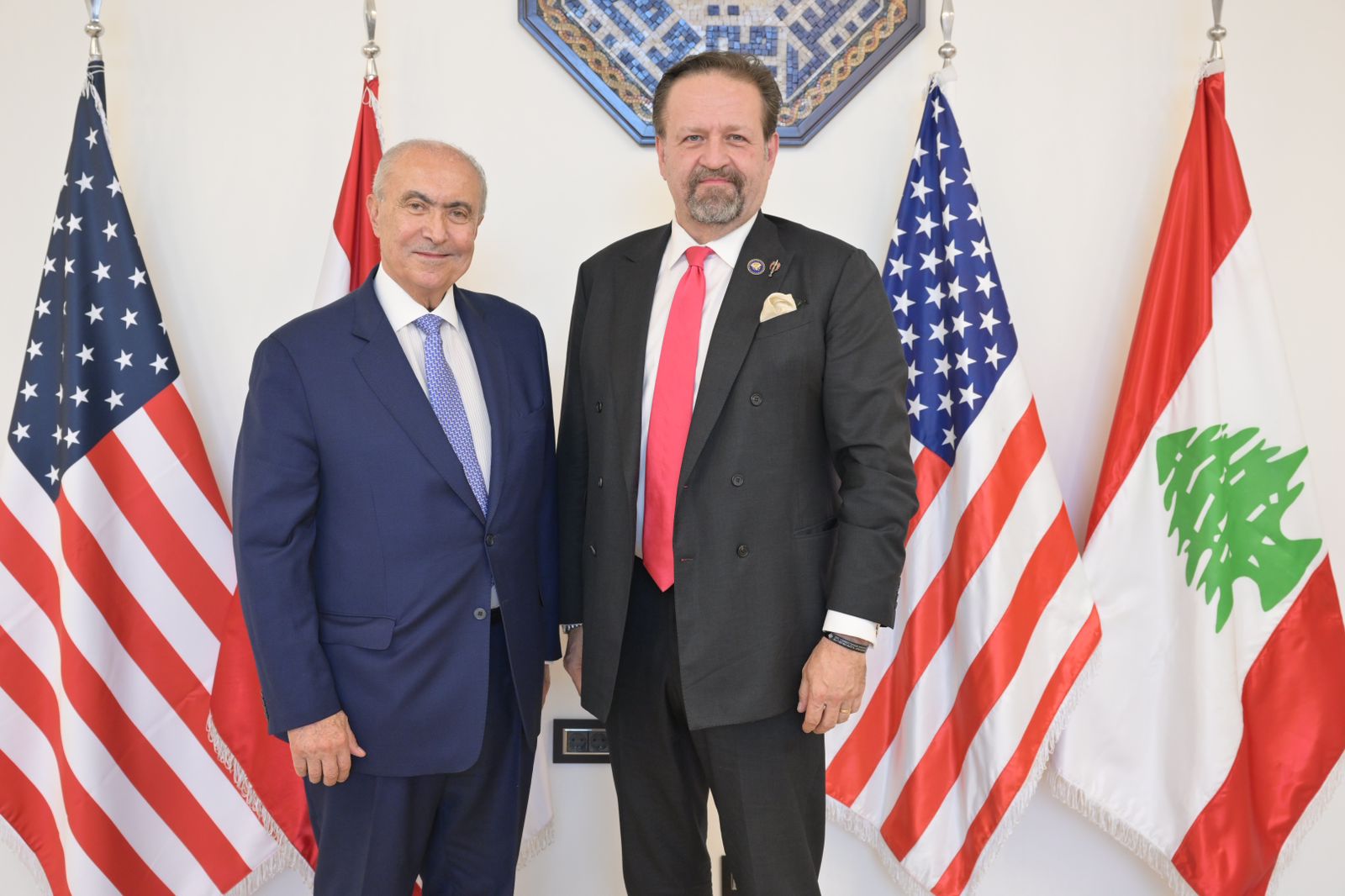
Key excerpts from my remarks at a dinner I hosted in honor of Dr. Sebastian Gorka, Deputy Assistant to the President and Senior Director for Counterterrorism at the U.S. National Security Council; Mr. John K. Hurley, Under Secretary of the U.S. Treasury for Terrorism and Financial Intelligence; and their accompanying delegation
Your Excellencies, distinguished guests, dear friends,
It is my pleasure to welcome you this evening as we gather to honor Dr. Sebastian Gorka, Deputy Assistant to the President and Senior Director for Counterterrorism at the U.S. National Security Council, and Mr. John K. Hurley, Under Secretary of the U.S. Treasury for Terrorism and Financial Intelligence, along with their distinguished colleagues from Washington.
We are deeply grateful for your presence in Lebanon and for the United States’ enduring commitment to our country—a partnership built on peace, democracy, transparency, and the rule of law.
Your engagement through the National Security Council and the U.S. Department of the Treasury reflects America’s commitment to strengthening security, financial integrity, and regional stability—the two pillars of peace and sovereignty.
Dr. Gorka, your leadership at the National Security Council embodies the United States’ determination to confront terrorism and violent extremism—not merely as a security threat, but as a moral challenge to peace and human dignity.
We also recognize the lasting impact of President Donald Trump’s policy in the Middle East, which has strengthened regional security, deterred aggression, and offered a vision of peace grounded in strength, clarity, and shared values.
Mr. Hurley, your leadership of the Treasury Department’s Office of Terrorism and Financial Intelligence complements this mission by ensuring that the global financial system cannot be exploited by financiers of terrorism, corruption, and destabilization.
We commend the recent measures taken by the U.S. Treasury Department to expand sanctions against individuals and entities linked to Hezbollah and its financial networks. These measures strengthen Lebanon and its sovereignty by reinforcing transparency, accountability, and the rule of law—fundamental principles for restoring confidence in our economy and advancing lasting peace.
We fully share the priorities you have identified for Lebanon:
- Combating illicit cash transactions and unregulated exchange companies;
- Formalizing the economy;
- Targeting entities linked to terrorism, narcotics, and Captagon;
- Applying sanctions as a precision tool.
These are not only your priorities; they are ours as well.
They point toward the same path forward—a path that requires structural reform, institutional integrity, and the full restoration of state capacity.
This is precisely why Lebanon’s reform agenda is built around seven core priorities—a roadmap fully aligned with your objectives and essential to rebuilding sovereignty and stability.
Reform is not merely a technical exercise; it is an act of sovereignty.
Our reform priorities are clear and closely aligned with yours:
1. Restructuring the banking and financial sector
This is essential to restoring the health of Lebanon’s financial system, moving away from the cash-based economy, reactivating lending to the private sector, and protecting depositors.
Comprehensive restructuring—in line with Basel III standards and International Monetary Fund requirements—must ensure sustainable capitalization, transparency, and independent supervision through a credible bank resolution framework.
Lebanon cannot combat the cash economy without restoring confidence in its banks.
2. Stabilizing monetary policy and the exchange rate
This requires unifying the exchange rate, supported by disciplined monetary policy and international assistance, to restore stability, contain inflation, and rebuild confidence.
3. Reducing the cash-based economy
The World Bank estimates that Lebanon’s cash economy reached approximately $10 billion in 2022, equivalent to 45% of GDP.
Implementing Know Your Customer (KYC) procedures, anti-money laundering and counter-terrorist financing measures, and mandatory reporting requirements, alongside expanding digital payments and financial inclusion, is essential to strengthening transparency and bringing liquidity back into the formal economy.
4. Border management and trade facilitation
This requires adopting digital customs systems, conducting container inspections, and exchanging data to curb smuggling, while aligning Lebanon with the standards of the Financial Action Task Force (FATF) and the World Customs Organization (WCO).
5. Financial governance and transparency
This means adopting e-budgeting, tracking public expenditure, and conducting forensic audits to ensure that every public dollar serves the public interest.
6. Disarming all militias
A sovereign state cannot coexist with multiple centers of power.
Disarming Hezbollah and all militias is vital to restoring the rule of law and national unity.
7. Complete border demarcation
Completing border demarcation with Israel, Syria, and Cyprus will safeguard Lebanese territorial integrity and contribute to regional peace.
Lebanon’s strength lies in its diversity—the coexistence of religions and cultures that defines our national identity.
Protecting all religious communities and minorities, particularly the Christian community, is essential to preserving Lebanon’s uniqueness and stability.
We are committed to peaceful and constructive relations with all our neighbors, founded on mutual respect and cooperation.
However, genuine peace requires confronting Iran’s proxies, foremost among them Hezbollah, whose dominance undermines Lebanon’s sovereignty and the regional order.
Support for the Lebanese Armed Forces must be aligned with U.S. and Lebanese strategic objectives: countering Hezbollah’s influence, curbing Iranian penetration, and ensuring the full implementation of United Nations Security Council Resolution 1701.
A strong and unified Lebanese Army is the cornerstone of Lebanon’s sovereignty and the guarantor of peace in our region.
Dr. Gorka and Mr. Hurley, your presence here tonight reaffirms that the United States stands with Lebanon—in our shared fight against terrorism, corruption, and financial crime, and in our collective pursuit of restoring confidence and sovereignty.
Your example reminds us that peace and prosperity depend on good governance, financial integrity, and the rule of law.
We share your vision of a Middle East founded on stability and cooperation rather than extremism and division; on transparency and opportunity rather than corruption and fear.
Dr. Gorka, Mr. Hurley, and your distinguished colleagues, we thank you for your dedication, your partnership, and your faith in Lebanon’s potential.
Before concluding, I would also like to pay tribute to Chargé d’Affaires Ambassador Keith Hannigan and commend the exceptional work of the U.S. Embassy in Lebanon. Under his leadership, the Embassy continues to strengthen U.S.–Lebanese relations and advance our shared objectives of peace, reform, and stability.
Thank you, and once again, welcome.