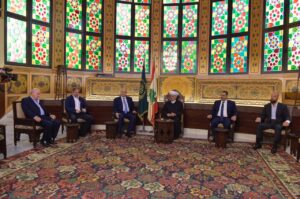
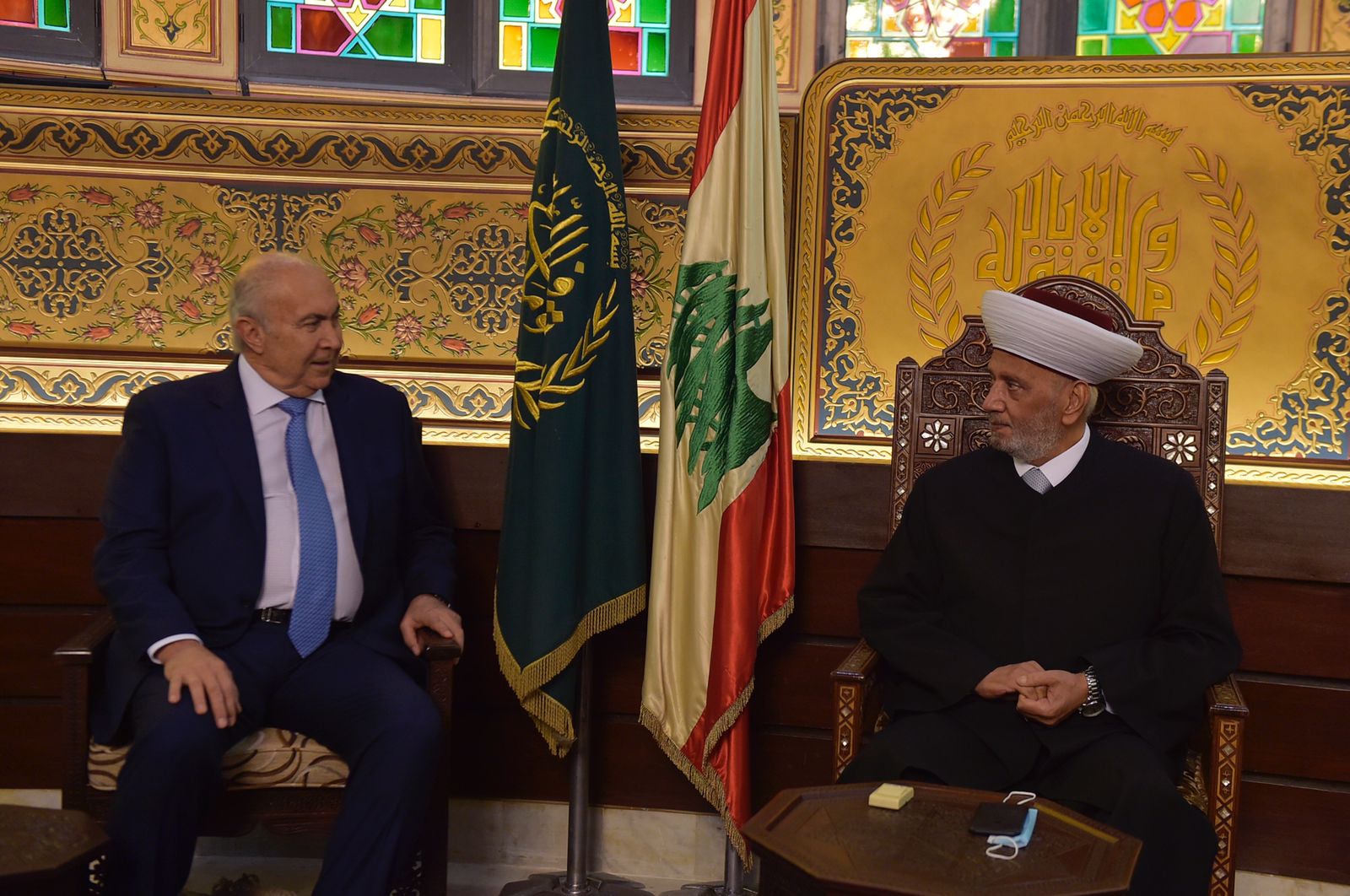
President of the National Dialogue Party, MP Fouad Makhzoumi, visited the Grand Mufti of the Republic, His Eminence Sheikh Abdul Latif Derian, at Dar Al-Fatwa, accompanied by Engineer Ibrahim Zaidan, Executive Deputy Chairman of the Party’s Administrative Board; Dr. Duraid Oweidat, Deputy Secretary-General of the National Dialogue Party; Samer Safah, Director General of the Makhzoumi Foundation; and Marwan Sabban, Marketing Director. They discussed matters related to Dar Al-Fatwa and the general situation in the country.
Makhzoumi said the visit focused on three key issues. The first was government formation, which had become something of a “farce,” given the insistence of various political forces on fighting over shares and seats. He asked whether the ruling establishment had read the ESCWA report indicating that the multidimensional poverty rate in Lebanon had doubled, rising from 42% in 2019 to 82% of the population in 2021. He also questioned whether the authorities were aware of the daily queues of “humiliation” that citizens were forced to endure.
Makhzoumi said the second issue was the lifting of subsidies, noting that the ruling establishment was concerned solely with its own interests and was seeking further ways to seize what remained of depositors’ funds held at Banque du Liban. He pointed out that Parliament and the Higher Defense Council had approved the opening of a temporary account worth $225 million to cover subsidies, even though the Governor of Banque du Liban had announced that subsidies would be lifted at the end of September. He added that each sect had its own cartels engaged in smuggling gasoline, diesel, medicine, and other essential goods. This temporary account, he warned, would benefit the owners of these cartels, who would purchase subsidized goods, hoard them as they had done in the past, and sell them on the black market after September.
The third issue was the parliamentary elections. Makhzoumi said that the statements currently circulating about the elections not being held if a government was not formed were unacceptable. He asked whether Lebanon had been “deeded” to these leaders and this ruling establishment, which had brought the country to its current dire state of corruption and deterioration across all sectors.
Makhzoumi said that His Eminence the Grand Mufti had been understanding of all their concerns, noting that the situation in the capital, Beirut, was dire. He added: “After contacting officials to resolve the diesel crisis and ensure supplies for businesses in Beirut’s markets, it became clear that the relevant authorities had no serious intention of finding any solutions in the near future.”
He continued: “It is regrettable that downtown Beirut has become a ghost town.” He questioned whether this reflected hostility toward the capital or political spite, and called on everyone, individuals and associations alike, to cooperate for the sake of Lebanon and its capital.