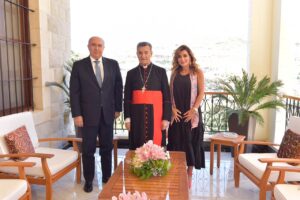
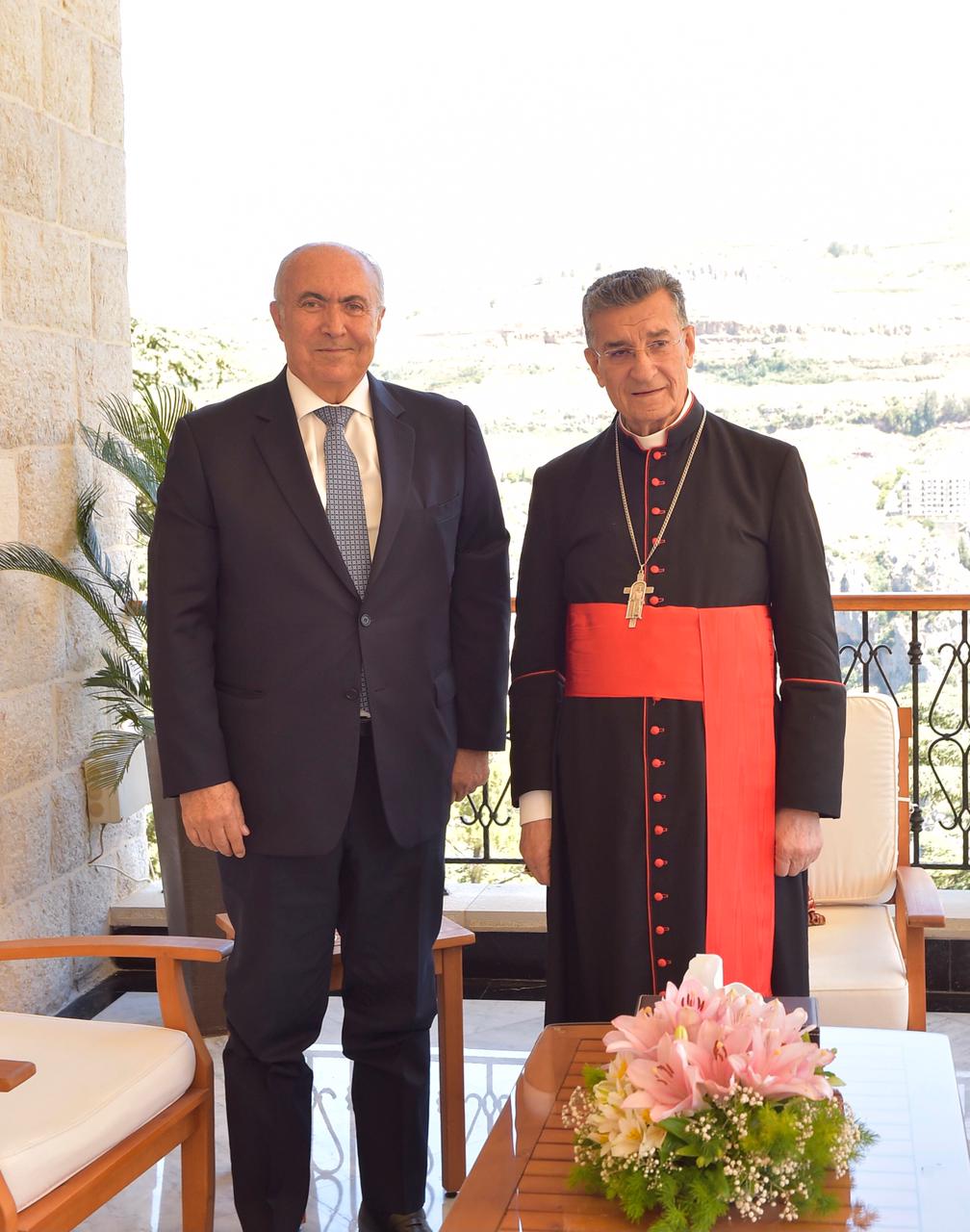
President of the National Dialogue Party, MP Fouad Makhzoumi, accompanied by Political Advisor Dr. Carol Zouein, visited Maronite Patriarch Cardinal Mar Bechara Boutros Al-Rai in Dimane. They discussed the general situation in Lebanon.
Makhzoumi said: “Our meeting with His Beatitude was to discuss the latest difficult developments facing the country.” He noted that the grim anniversary of the Beirut Port explosion on August 4 was approaching, and expressed his sadness that the ruling class—or the corrupt class, as the people call it—which had brought the country to ruin on every level, had promised to identify those responsible for this crime, yet there had been no progress in the case to date.
He continued that when the judge, whom he holds in high regard and respects and believes is capable of conducting a transparent investigation and bringing about change, raised the issue of lifting immunity from those accused in connection with the August 4 explosion, the corrupt political class decided to remove the investigation involving ministers and MPs from the Judicial Council and refer it to the Supreme Council for the Trial of Presidents and Ministers. He noted that the same ruling class dominates this court and that, even if it were to issue a decision, approval from two-thirds of Parliament would still be required.
He considered this move tantamount to putting an end to the investigation and efforts to lift immunity, stressing that he had been among the first to call for the lifting of immunities and continued to do so.
Makhzoumi said the other issue he discussed with His Beatitude was the parliamentary consultations scheduled to begin the following Monday to designate a prime minister. He noted that the international community was awaiting an independent government capable of implementing reforms so that Lebanon could be rebuilt and its international standing and credibility restored.
He pointed out that the political landscape was no longer divided between the March 8 and March 14 alliances, but instead consisted of a uniformly corrupt political class protecting its members across the government, Parliament, various state institutions, and the judiciary.
He argued that the only person capable of rescuing the country from its current predicament was someone despised and rejected by the ruling class, which, he said, hid behind the concept of constitutional legitimacy. He stressed that this political establishment would not accept reforms.
He also referred to what he described as the latest political farce: borrowing $860 million to buy electoral support under the guise of the “financial support card.” He added that Lebanon needed a genuinely independent government composed of individuals from outside the ruling establishment.
Makhzoumi urged expatriates to help their country, noting that they had been the only ones to provide tangible support to Lebanon since the civil war, transferring between $5 billion and $7 billion annually—an amount greater than any assistance that could be provided by the International Monetary Fund or the World Bank.
Addressing the ruling establishment, he said it could not continue to play political games at the regional level and take sides in ongoing conflicts, as this could affect more than 450,000 Lebanese living in the Gulf countries.
In response to a question about whom he believed should be designated to form the government, Makhzoumi said the issue was not about the individual occupying the position of prime minister, but rather about having the right program and appropriate reform plans. In his view, the existing political establishment would not allow anyone who might expose its corruption and reopen all the cases implicating its members to take on this responsibility.
He affirmed that he was prepared to assume the task of forming a government if there were a genuine intention to implement reforms.