
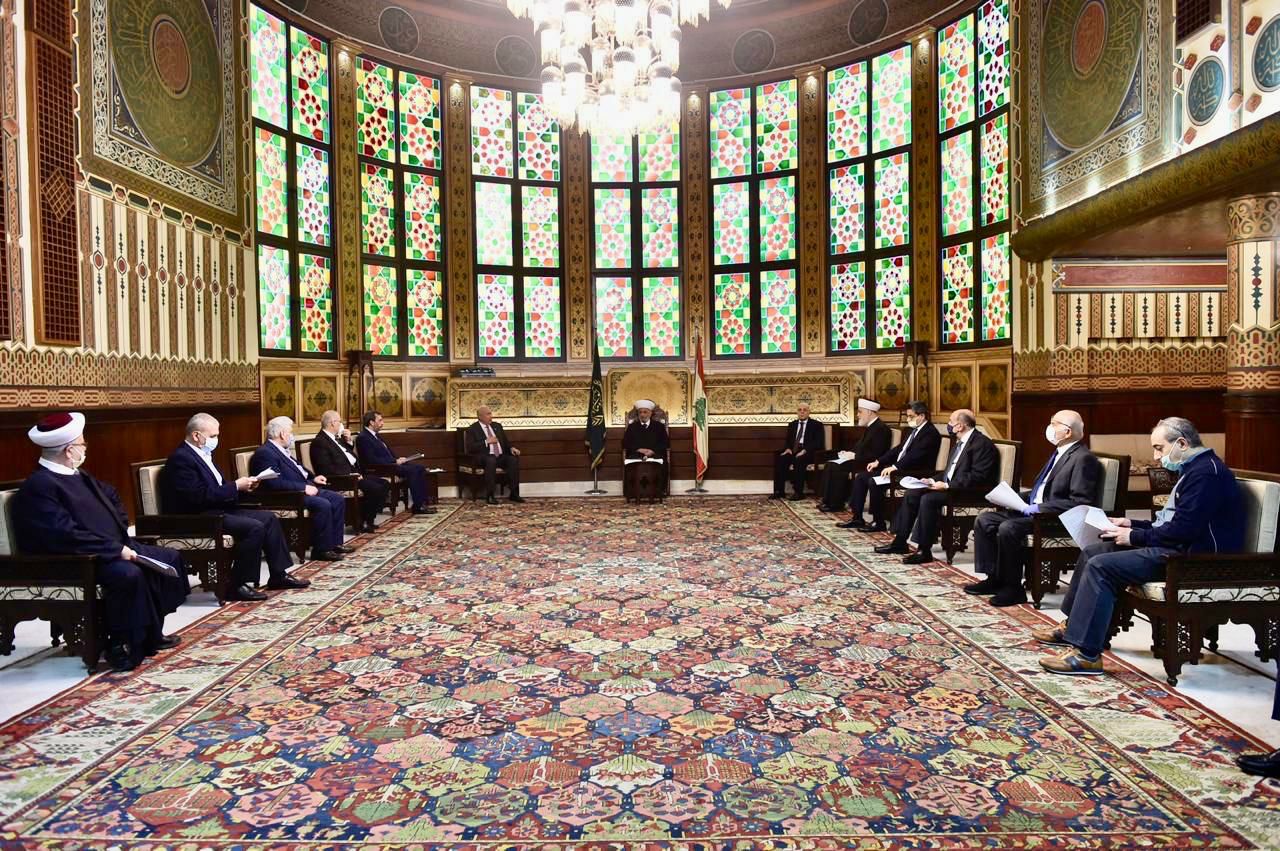
At Dar al-Fatwa, under the patronage of Grand Mufti Sheikh Abdul Latif Derian, the Coalition of Relief and Social Institutions was launched to address the cost-of-living crisis caused by the coronavirus pandemic. The launch was marked by the signing of a protocol on information sharing and cooperation, aimed at strengthening ties among Islamic associations and institutions active in relief, social welfare, care, and charitable work. The coalition seeks to unify joint efforts to meet the needs of low-income families, the poor, the needy, and orphans, and to provide all forms of assistance.
Grand Mufti Derian welcomed the launch of the coalition, wishing “success and good fortune to everyone carrying out this work sincerely for the sake of Almighty God, offering assistance and support to citizens suffering from a severe cost-of-living crisis. This crisis requires collective efforts to help people secure their daily bread amid the spread of the coronavirus.”
He said: “We are experiencing an unprecedented economic downturn in Lebanon, which calls for solidarity and unity among its people. The challenges facing our country are numerous and immense, and we must confront them through cohesion and unity, which will make us stronger in overcoming them. The door is open to any association, institution, or organization wishing to join this coalition. Dar al-Fatwa never closes its doors to anyone; rather, it works day and night to serve all Lebanese people.”
Derian explained that “this humanitarian initiative brought together a number of associations under the auspices of Dar al-Fatwa, which signed the protocol. They are: former Minister Dr. Khaled Kabbani, representing the Islamic Orphanage; MP Fouad Makhzoumi, representing the Makhzoumi Foundation; Dr. Imad El Hout, representing the Islamic Group; Dr. Mahmoud Faour, representing the Islamic Home for the Elderly; Dr. Wassim Al-Wazzan, representing the Dr. Mohammad Khaled Social Institutions; Dr. Ahmad Houri, representing the Ibad al-Rahman Group; Engineer Ali Assaf, representing the Islamic Center; Dr. Imad Itani, representing the Zakat Fund; Engineer Jamal Mahyou, representing the Irshad and Islah Association; Sheikh Ziad Al-Saheb, representing the Al-Futuwwa Association; Mr. Mohammad Afif Yamout, representing the Beirut Families Associations Union; Mohammad Khaled Sinno, representing the Relief and Humanitarian Aid Authority at Dar al-Fatwa; Osama Shuqair, representing the Beirut Association for Social Development; Assem Nawam, representing the Irada Association; Sheikh Hassan Qaterji, representing the Islamic Union Association; Dr. Lina Dada, representing the Ajialouna Association; and Nada Merabi Itani, representing the Intima’i Association.”
Makhzoumi
Grand Mufti Derian also received MP Fouad Makhzoumi, who said: “We commend this initiative, which highlights the importance of social work beyond political affiliations. Such initiatives always need a patron, as well as coordination among charitable and social associations representing different religious communities, particularly given that poverty in Lebanon has reached levels no one could have imagined. The meeting focused on the importance of coordinating donations and social assistance and determining how they should be distributed.”
He added: “Everyone knows that charitable associations exist, but some have political affiliations. His Eminence stressed the need to set these affiliations aside and work in the best interests of Lebanon and its people, as the social and economic situation requires a concerted effort amid the coronavirus crisis.”
He continued: “The various associations highlighted an extremely important issue: how to access the funds held in banks. It is true that Banque du Liban Governor Riad Salameh tried to act on the proposal we had submitted, which called for allowing small depositors whose deposits do not exceed $3,000 to withdraw their money. However, the method they devised is not what we had called for, because it helps banks eliminate small depositors’ accounts and consequently reduce the number of bank employees under the pretext that their services are no longer needed.”
He noted that “the protection previously afforded when the official dollar exchange rate stood at LBP 1,500 no longer exists today and has become subject to arbitrary decisions, with banks determining the exchange rate themselves. This amounts to yet another crime committed by the banks, and it must be rejected.”
He added: “All the charitable associations stressed today that the most important priority is to release the funds held by banks in the same currency in which they were deposited, enabling them to assist citizens. This will be a top priority for the relevant coalition team. We hope a solution to this issue can be found, although we see no genuine willingness on the part of the Banque du Liban governor or the banks to address it.”
In response to a question about the families that would benefit from the coalition’s initiative, Makhzoumi said: “His Eminence instructed the coalition to unify the lists maintained by institutions providing social assistance in order to avoid duplication in the distribution of aid.”
Regarding the repatriation of Lebanese expatriates, he said: “This is a positive step. Middle East Airlines is a company owned by the Lebanese people, not a private company. Given the current circumstances, we had hoped the airline would treat our people differently rather than raising ticket prices, as this would prevent many Lebanese from returning to their homeland.”
He stressed that “banks have no right to refuse to release the funds of expatriates who do not wish to return to Lebanon.”