
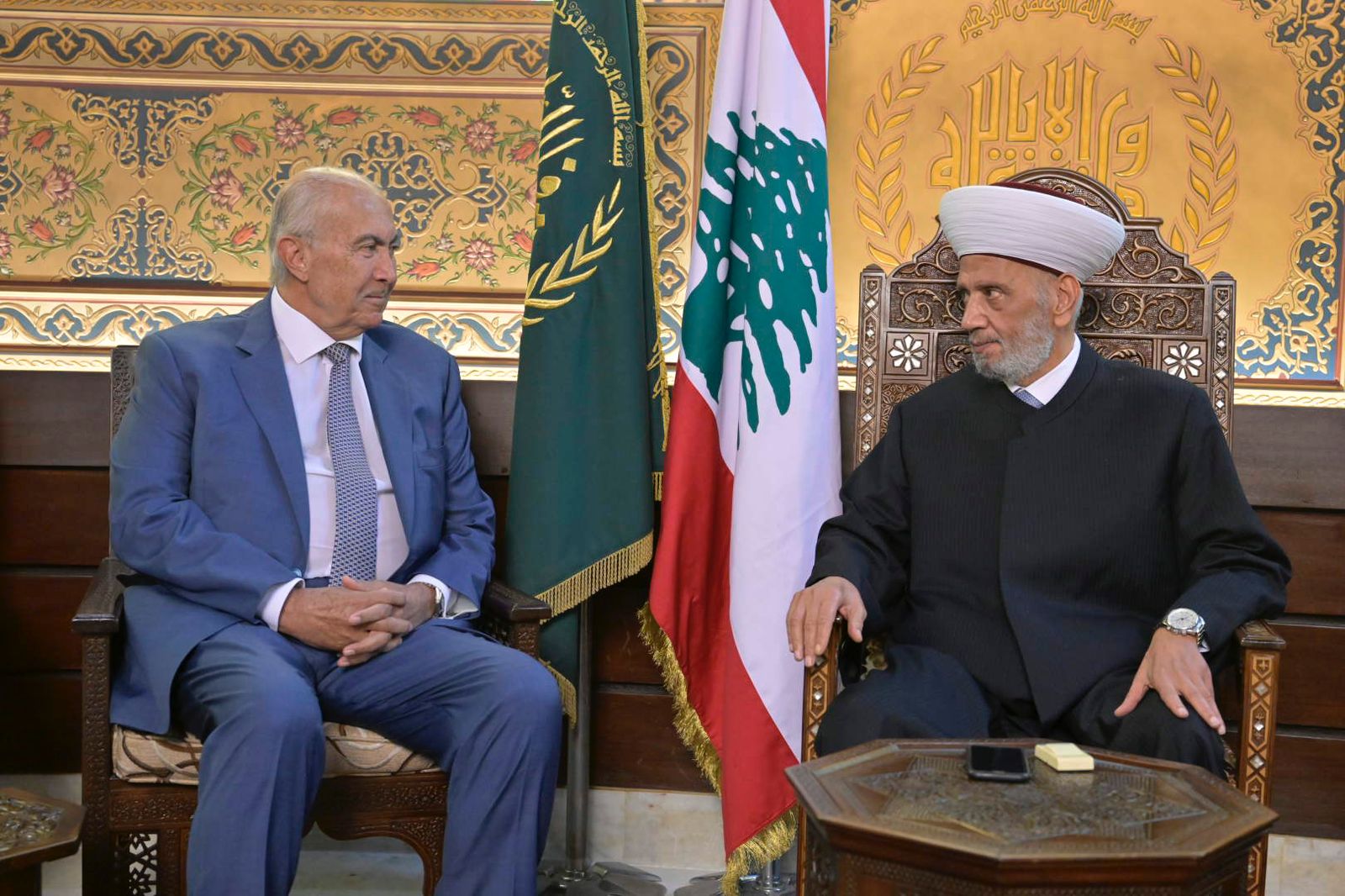
President of the National Dialogue Party, MP Fouad Makhzoumi, visited the Grand Mufti of the Lebanese Republic, His Eminence Sheikh Abdul Latif Derian, at Dar al-Fatwa, accompanied by the Party’s Deputy Secretary-General, Dr. Duraid Oweidat; Diplomatic Adviser and former Ambassador Dr. Bassam al-Naamani; and Makhzoumi Foundation Director General Samer al-Safah. They discussed matters concerning Dar al-Fatwa and the general situation in the country.
Following the meeting, Makhzoumi said that the purpose of the visit was to discuss the situation in the country, particularly developments concerning Banque du Liban following the end of the Governor’s term and the assumption of the governorship by the First Deputy Governor.
Regarding the emergency plan announced by the four Deputy Governors, Makhzoumi said he wished they had presented it at the beginning of the crisis and spoken out forcefully in support of its implementation. He considered that the plan could be beneficial if linked to reforms and to the platform requested by the International Monetary Fund (IMF). He added that these Deputy Governors had been appointed in 2020 and had therefore entered the process with full awareness of its circumstances. He called on them to assume the responsibilities they had accepted three years ago, stressing that the country could no longer tolerate further corruption and mismanagement.
Referring to the draft law that the Prime Minister intends to introduce to provide Banque du Liban with a financial loan funded from the Central Bank’s mandatory reserves, Makhzoumi noted that these reserves had fallen from $32 billion in 2019 to $9 billion today, whereas they should stand at between $11 billion and $12 billion. He said Banque du Liban had spent people’s money under the pretexts of subsidies and exchange-market operations.
In this context, Makhzoumi expressed surprise at how the caretaker Prime Minister could advance a draft law that would authorize the depletion of the Central Bank’s mandatory reserves and further erode depositors’ funds. He described this as mismanagement of the Lebanese people’s money.
Makhzoumi continued: “Seventeen months have passed since the agreement with the International Monetary Fund was signed on April 7, 2022, yet not a single reform has been passed to date.” He added that talk of convening a legislative session to draw on depositors’ funds was unacceptable, emphasizing that it would be more appropriate for MPs to convene to elect a President of the Republic.
Regarding the Ain al-Hilweh refugee camp, Makhzoumi stressed that the developments there were extremely dangerous and that a breakdown in security was clearly evident, noting that the Palestinian President had asked the Lebanese government to assume responsibility for security inside the camps. He emphasized the need to hand over those involved in the killings and leave the matter to the judiciary to carry out its role and protect Lebanon.
Makhzoumi thanked His Eminence the Grand Mufti for his initiative aimed at bringing MPs back together, particularly as the country faces upcoming milestones and the region moves toward political settlements. He stressed the need to develop a plan for Lebanon and work together to help the country overcome its crises.
He also praised the efforts of the Quintet Committee, which met in Doha, and reiterated the importance of the five safeguards put forward by Saudi Arabia, as well as Saudi Arabia’s adherence to its position regarding the qualifications and characteristics required of the President of the Republic.