
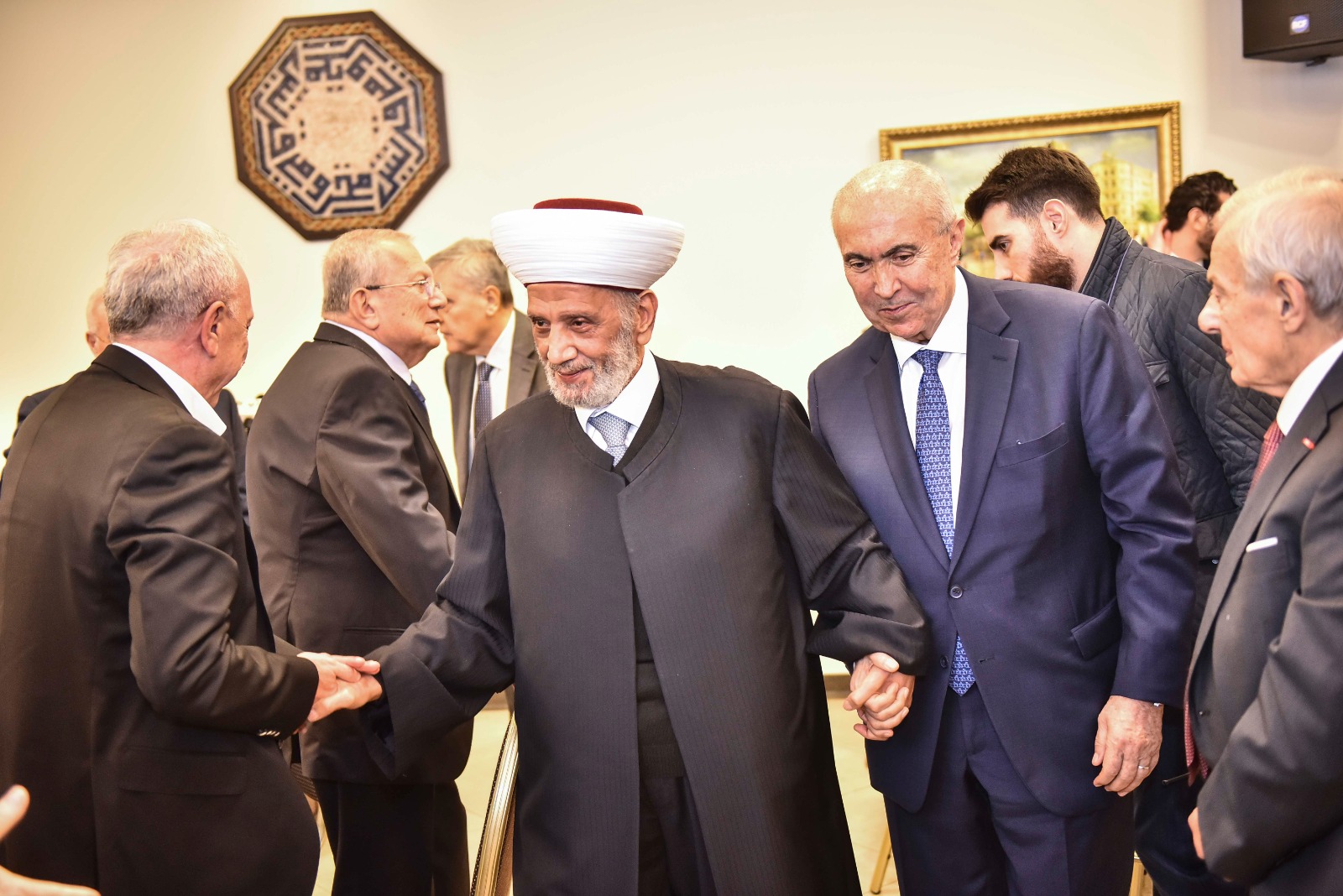
MP Fouad Makhzoumi, President of the National Dialogue Party, and his wife, Mrs. May, hosted a Ramadan iftar at their residence in honor of His Eminence Grand Mufti Sheikh Abdul Latif Derian. The gathering was attended by a number of current and former MPs and ministers, Arab ambassadors, religious and spiritual leaders, heads of associations, prominent figures, media representatives, as well as members of MP Makhzoumi’s team and his wider network across various institutions.
Welcoming the guests and His Eminence the Grand Mufti, Makhzoumi said that Lebanon was placing its hopes in the role of the Grand Mufti, whom he considers a national spiritual authority and a symbol of moderation, as well as in Dar al-Fatwa, which he described as a key religious institution that plays a unifying role during this delicate period in the country’s history.
Makhzoumi noted that Lebanon was going through a difficult phase, as the country was in a state of war, even if geographically more limited than the conflict of 2006. He called for cooperation to achieve a just and comprehensive solution and spare Lebanon a war that everyone rejects. He expressed hope that the United Nations Security Council resolution calling for an immediate ceasefire in Gaza during the holy month of Ramadan would be implemented, considering that such a truce could pave the way for a just and comprehensive settlement in line with the Arab Peace Initiative adopted at the 2002 Beirut Summit, based on the two-state solution and the principle of land for peace.
Makhzoumi said Lebanon must also be a party to international agreements and to their implementation. He reiterated his call for all parties to implement United Nations Security Council Resolution 1701 in full and in all its provisions, while also underscoring the need to uphold the Constitution and the Taif Agreement, which has been and will remain a roadmap and a safeguard for the country and its people. He thanked the Arab ambassadors for their support and solidarity with Lebanon, stressing that the country could not recover without its Arab and international support network.
Turning to Beirut, Makhzoumi said the capital was suffering from water and electricity shortages, among other pressing everyday challenges. He stressed that government action was needed to revitalize all state institutions. He reiterated his firm position in favor of holding municipal elections and called on everyone to cooperate in the best interests of Beirut and all of Lebanon.
For his part, His Eminence the Grand Mufti thanked Makhzoumi for hosting the gathering. He remarked that the MP, who had brought people together every Ramadan at the Ramadan Village before the COVID-19 pandemic, was now welcoming them into his own home. He emphasized the importance of solidarity and unity in overcoming the major problems and crises facing Lebanon.
The Grand Mufti said the country’s fundamental problem lay in political conduct that divided its people. He affirmed that Lebanon belonged to all Lebanese and that no sect should dominate another. This, he noted, was enshrined in the Taif Agreement and was what needed to be implemented; there were no other demands.
Addressing the presidential election, the Grand Mufti observed that Lebanon had become accustomed to a presidential vacuum whenever a president’s term ended. He noted that Arab brothers had taken the initiative and extended a helping hand to Lebanon to facilitate the completion of this constitutional milestone amid the difficult circumstances facing the country and the region. He expressed regret that politicians seemed adept at undermining initiatives and turning blessings into burdens. He stressed that all MPs must fully discharge their responsibilities to complete this pivotal constitutional process.
He also emphasized that the five-member committee did not seek to impose a presidential candidate, but rather to establish the criteria and qualifications that anyone aspiring to reach the presidential palace should possess.
His Eminence further affirmed that Lebanon’s spiritual and religious authorities were not political parties, but institutions entrusted with safeguarding the Constitution and peaceful coexistence.
In conclusion, Makhzoumi invited the attendees to join him at the iftar table.