
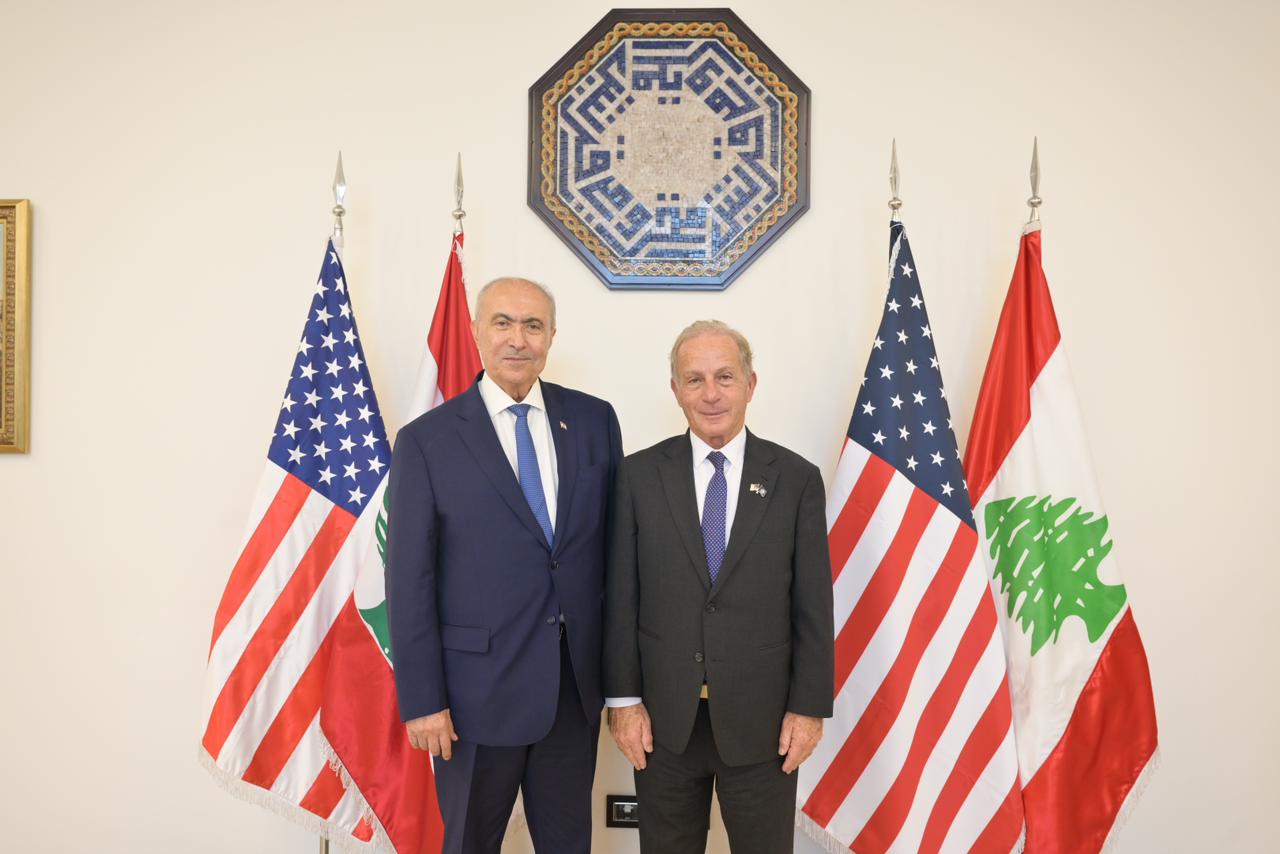
Remarks delivered at a dinner in honor of U.S. Ambassador Michel Issa and the American Task Force on Lebanon:
Your Excellencies, distinguished guests, dear friends,
It is an honor to welcome you this evening as we gather to recognize the valuable work of the American Task Force on Lebanon—a organization whose commitment to our country has remained unwavering despite all the challenges. Your engagement, advocacy, and clarity of vision continue to offer hope and direction at a time when Lebanon needs both more than ever.
Tonight, we extend a special welcome to Ambassador Michel Issa and his beloved wife, Liliane. Your Excellency, your arrival in Beirut is more than a diplomatic appointment; it represents a renewed vote of confidence at a moment when national challenges intersect with new opportunities for our country. Your experience, vision, and deep understanding of the complexities of Lebanon’s realities make you an indispensable partner. Your presence reassures us that the United States remains committed to Lebanon, its reform, and its stability.
Sovereignty, Resolution 1701, and the Challenge of Illegal Weapons
Lebanon’s fundamental challenge remains clear and unresolved: no state can function while armed groups operate outside the authority of its institutions.
For nearly two decades, United Nations Security Council Resolution 1701 has served as the principal framework for stability in southern Lebanon. It clearly called for the area south of the Litani River to be free of any armed personnel, assets, and weapons other than those of the Lebanese Army and UNIFIL. Yet the resolution has been only partially implemented, undermining Lebanon’s sovereignty and credibility with its international partners.
The cessation of hostilities agreement of November 27, 2024, reaffirmed Lebanon’s responsibility to ensure that no armed groups operate outside the authority of the state. It represents a critical opportunity to break the recurring cycle of escalation and restore the Lebanese state’s authority over all security matters.
But agreements alone do not make peace. Implementation does.
In this context, Lebanon took an important and courageous step when President Joseph Aoun appointed Ambassador Simon Karam to the committee overseeing the implementation mechanism for Resolution 1701. This is a strong indication of Lebanon’s seriousness about restoring state authority.
However, no mechanism can succeed unless its mandate is respected.
The continued military infrastructure of Hezbollah, alongside the weapons held by Palestinian factions and other militias, constitutes a violation of Resolution 1701, undermines the cessation of hostilities agreement, and erodes the very concept of sovereignty.
It obstructs reform, weakens institutions, and leaves Lebanon hostage to regional agendas—particularly Iran’s, which has consistently used Lebanon as an arena for its strategic confrontations.
For decades, Iranian policies have deepened divisions, strengthened militias at the expense of the state, fueled regional conflicts, and prevented Lebanon from achieving stability and normalcy. They have forced the Lebanese people to bear consequences they neither chose nor deserved.
Lebanon seeks normalcy, sovereignty, and peace—not perpetual instability imposed from abroad.
Peace begins with one fundamental principle: the Lebanese state alone must hold the exclusive authority over weapons, without exception.
Disarming all militias—Hezbollah, Palestinian factions, and others—is not optional. It is an indispensable foundation for sovereignty, stability, and national renewal.
Complete Border Demarcation: A Cornerstone of Sovereignty
Sovereignty also requires clearly defined borders.
Lebanon must complete the demarcation of its borders with all its neighbors: Syria, Israel, and Cyprus. This is essential not only for security and the protection of natural resources, but also for eliminating any pretext used by non-state actors to drag Lebanon into conflict every few years.
Ambiguities surrounding borders have repeatedly been exploited to justify illegal weapons and illicit military activities. Complete border demarcation strengthens the state and puts an end to these pretexts once and for all.
Reform, Banking Sector Restructuring, and the Cash Economy
Alongside the security crisis, Lebanon faces an equally devastating economic crisis.
Lebanon’s unregulated cash-based economy has become a haven for corruption, smuggling, illicit financing, and tax evasion. It undermines institutions, destroys transparency, and isolates Lebanon from global markets.
Reform must therefore be urgent, structural, and credible. It must include:
- Restructuring the banking sector with transparency, sound capitalization, depositor protection, and independent oversight, while completing a comprehensive audit to determine the true scale of the financial gap.
- Ensuring debt sustainability and restoring fiscal credibility.
- Combating the cash economy by enforcing anti-money laundering and counter-terrorist financing rules, restricting large cash transactions, and modernizing payment systems.
- Restructuring the public sector to make it efficient, transparent, and capable of serving citizens.
- Ensuring full transparency at the borders and putting an end to smuggling, which drains state revenues and strengthens illicit networks linked to armed groups.
These reforms are essential to restoring confidence in the Lebanese state, its economy, and its institutions. In this regard, Ambassador Issa and ATFL are indispensable partners.
Elections and Democratic Renewal
No reform can be complete without democratic legitimacy.
Lebanon must hold its parliamentary elections on schedule, and Lebanese expatriates must retain their right to elect all 128 members of Parliament.
The Lebanese diaspora is one of Lebanon’s greatest sources of strength—a global source of creativity, resilience, and national engagement. Its participation strengthens the credibility of our institutions and the unity of our nation.
A Shared Path Toward Peace and State-Building
Lebanon does not aspire to war. Lebanon aspires to peace—a peace founded on sovereignty, the rule of law, and transparent governance.
A Lebanon in which the state alone exercises authority over its territory, borders, and weapons.
A Lebanon capable of economic recovery, political reform, and regional stability.
A Lebanon that chooses its own destiny, free from coercion, fear, and foreign interference.
With partners such as the United States—guided by President Trump’s vision and strategy, supported by Ambassador Michel Issa’s leadership in Lebanon, and strengthened by the tireless work of ATFL—this aspiration can become a reality.
Conclusion
Ambassador Issa, Mrs. Liliane, members of ATFL, dear friends,
Thank you for your dedication, your confidence in Lebanon, and your enduring belief in our ability to rise again.
Together, we can lead Lebanon toward a future defined not by crises, but by sovereignty, reform, democracy, and lasting peace.
Welcome once again, and thank you for your steadfast friendship.