
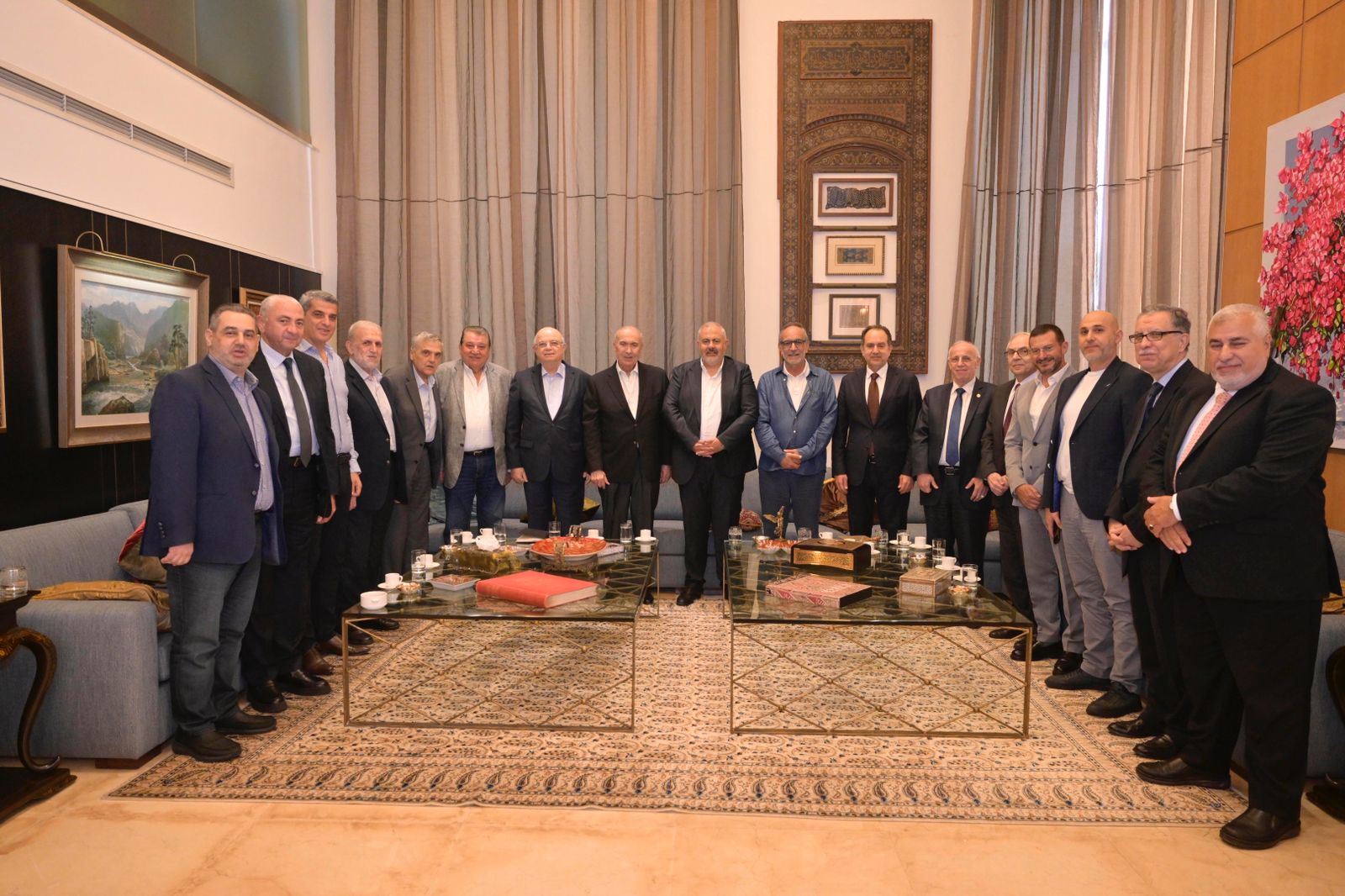
With the aim of safeguarding the interests of Beirut’s residents, addressing the risks facing them, and upholding the principle that “strength lies in cooperation,” the second meeting of the “Beirut Revival Initiative” was held at MP Fouad Makhzoumi’s residence. The meeting focused on Beirut’s deteriorating conditions, ways to revive the capital, and the factors and obstacles delaying the provision of the resources needed to implement essential projects in the city. It followed the initiative’s first meeting, held on April 22, 2024, at the home of Al-Liwaa newspaper’s Editor-in-Chief, Salah Salam.
In addition to MP Makhzoumi, attendees included Minister Mohammad Choucair; Dr. Ammar Houry, President of the Al-Birr wal-Ihsan Association; Beirut Governor Judge Marwan Abboud; Beirut Municipal Council President Abdullah Darwish; Dr. Faisal Sinno, President of the Makassed Association; Dr. Mazen Charbeji, President of the Makassed Alumni Association; Saadeddine Hamidi Sakr, Deputy Secretary-General of the General Confederation of Lebanese Workers; Ambassador Bassam al-Naamani, Vice President of the National Dialogue Party; lawyer Saeb Matarji, Secretary-General of the National Balance Initiative; engineer Jamal Mahyou, President of the Al-Islah wal-Irshad Association; Dr. Mohammad Alameddine; lawyer Mohammad Alam; engineer Assem Nawam, Vice President of Irada; engineer Bassam Barghouth, a member of the Makassed Board of Trustees; Samer al-Safah, Director General of the Makhzoumi Foundation; Kamel Damiati, a member of the Higher Islamic Sharia Council; engineer Bassem Oweini, Head of the Acquisitions Department at Beirut Municipality; and engineer Jihad al-Bikqai, Head of the Engineering Department.
In his remarks, MP Makhzoumi welcomed the participants and emphasized the importance of the meeting. He reviewed the disasters that had struck Beirut in recent times, particularly the restaurant explosion on Bashara al-Khoury Street, which exposed the extent of neglect, the lack of oversight, and the decline of public service and urban development projects. He called for the immediate launch of urgent projects to rehabilitate the capital’s infrastructure and facilities, foremost among them completing street lighting, activating traffic signals at major intersections, rehabilitating the drinking-water network, and implementing projects that had already been studied in cooperation with civil society and the private sector.
Minister Mohammad Choucair noted that, in 2019, government departments were already experiencing partial vacancies in their staffing. Today, he said, the rate of vacancies had risen, affecting the processing of citizens’ transactions. Government offices had effectively shifted to part-time operations instead of extending working hours. Meanwhile, citizens were incurring additional expenses to complete their transactions due to the spread of bribery. He called for concerted efforts to revive Beirut through cooperation between the public and private sectors.
Judge Abboud outlined the details of Beirut Governorate’s plan, which includes scheduling urgent projects that could be undertaken in cooperation with civil society and the private sector. He also addressed the fire incident on Bashara al-Khoury Street and stressed the need to begin a comprehensive survey of Beirut to identify all existing violations, whether involving licensing irregularities or other breaches and encroachments.
For his part, Beirut Municipal Council President Abdullah Darwish announced that a project to rehabilitate Beirut’s seafront, extending from Ramlet al-Baida to Zaitunay Bay, would begin within two weeks. He confirmed that the project’s funding had been secured through private donations and that the municipal council had approved it.
Salah Salam, Editor-in-Chief of Al-Liwaa newspaper, proposed prioritizing projects according to the capital’s most urgent needs and preparing a schedule for their implementation. This would allow the projects to be presented to institutions and individuals willing to contribute, according to a defined program and within the available resources.
The floor was then opened for discussion. Municipal engineers briefed the attendees on projects ready for implementation. It was decided to give priority to completing street lighting and rehabilitating the seafront. Participants would also be provided with studies for 14 projects ready to be presented at the next meeting, with the aim of securing funding from private donors and the relevant authorities.
Lawyer Mohammad Alam proposed introducing a modern operating system for municipal departments, adopting digitalization and financial transparency, combating bribery and corruption, and simplifying procedures for citizens paying fees and taxes.
Engineer Bassam Barghouth stressed the importance of engaging consulting firms for certain large-scale projects to help secure funding from Arab funds and international financial institutions.
Finally, the participants approved Salah Salam’s proposal to establish working committees, each responsible for following up on specific projects according to its area of expertise. The aim is to strengthen oversight and accelerate implementation. All projects will be carried out under the supervision of the Beirut Governor and the President of the Municipal Council, in accordance with applicable laws and regulations.