
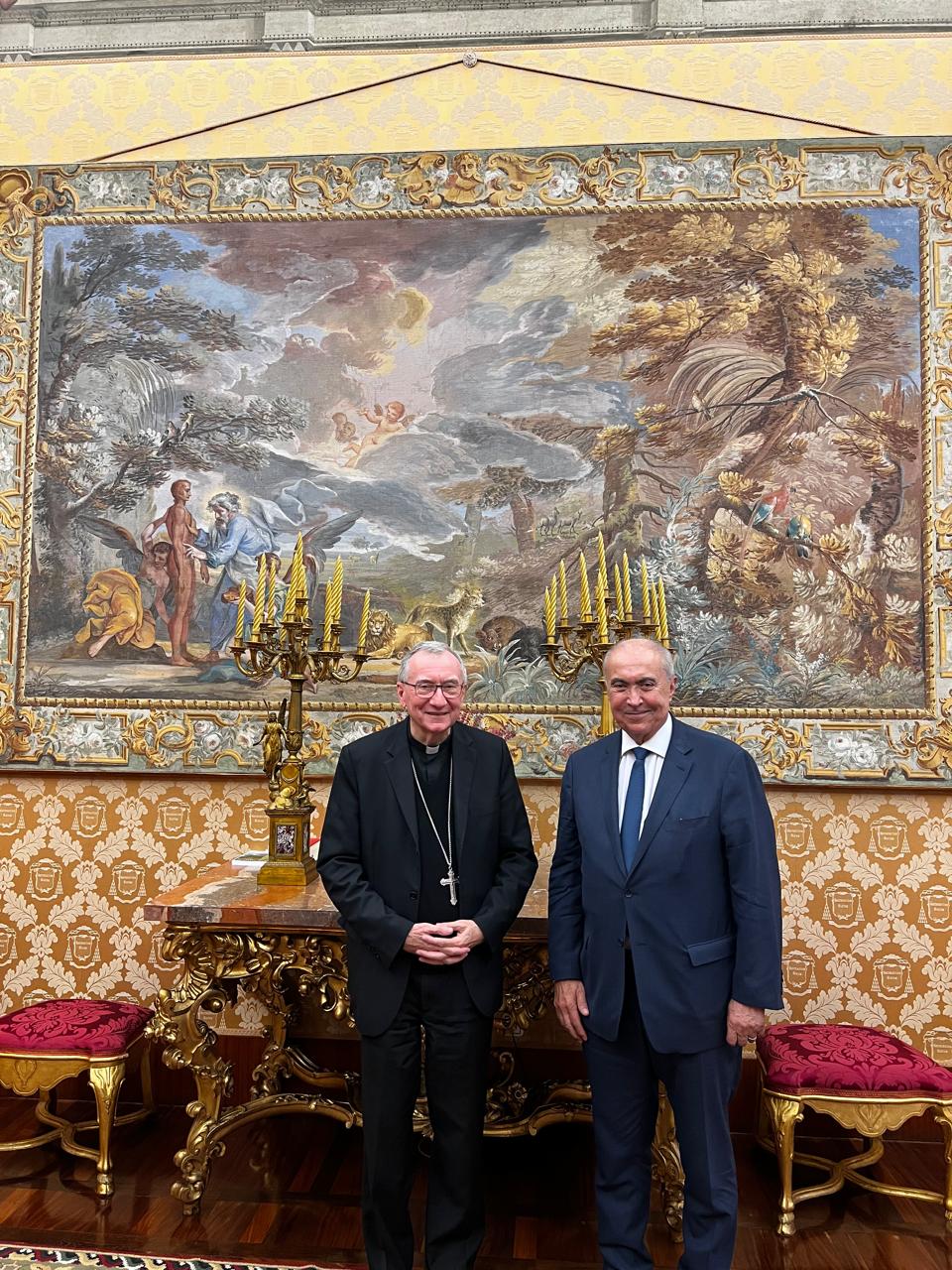
President of the National Dialogue Party, MP Fouad Makhzoumi, undertook a European tour that concluded with a visit to Italy. Accompanied by political adviser Carol Zouein, he met with Italian Minister of Defence Guido Crosetto, Vatican Secretary of State Cardinal Pietro Parolin, President of the Senate Committee on Foreign Affairs and Defence Stefania Craxi, and Maurizio Gerjanti, the official responsible for the Far East and the Gulf at Italy’s Ministry of Foreign Affairs.
During these meetings, Makhzoumi discussed several key issues, foremost among them the need for a ceasefire in Lebanon and the presidential election. He emphasized the importance of upholding and implementing the Taif Agreement to ensure political stability, securing an immediate ceasefire, and fully implementing UN Security Council Resolution 1701, along with all relevant international resolutions, particularly Resolutions 1680 and 1559.
At the same time, he stressed the need to support the Lebanese Army by strengthening its capabilities and enabling it to carry out all its duties, deploy its forces throughout Lebanese territory, and secure all border crossings and border areas. He also underscored the importance of ensuring that weapons are held exclusively by the state and supporting the restoration of its authority over decisions of war and peace.
Makhzoumi emphasized the urgent need to elect a President of the Republic without delay or hesitation, highlighting the importance of this position in shaping post-ceasefire agreements. He stressed that the president should be a reform-minded, sovereignty-focused leader capable of steering the country toward recovery while safeguarding the Constitution and Lebanon’s sovereignty. This would help restore the proper functioning of state institutions and pave the way for the formation of a government.
He further insisted that the presidential election must not be linked to other issues, explaining that ending the war in Lebanon and restoring security and stability require functioning state institutions at every level, starting with the presidency.
Makhzoumi also firmly rejected any interference in Lebanon’s internal affairs, stressing that safeguarding independent Lebanese decision-making and disentangling the country from regional axes and the war in Gaza had become more urgent than ever to save Lebanon and protect its people.
He concluded by reiterating the need to reorganize Lebanon’s international relations, both with Western and Arab countries, restore the international community’s confidence in the country, and rebuild its close ties with the Kingdom of Saudi Arabia and the Gulf states, while remaining committed to Arab and international legitimacy in accordance with the Taif Agreement.