
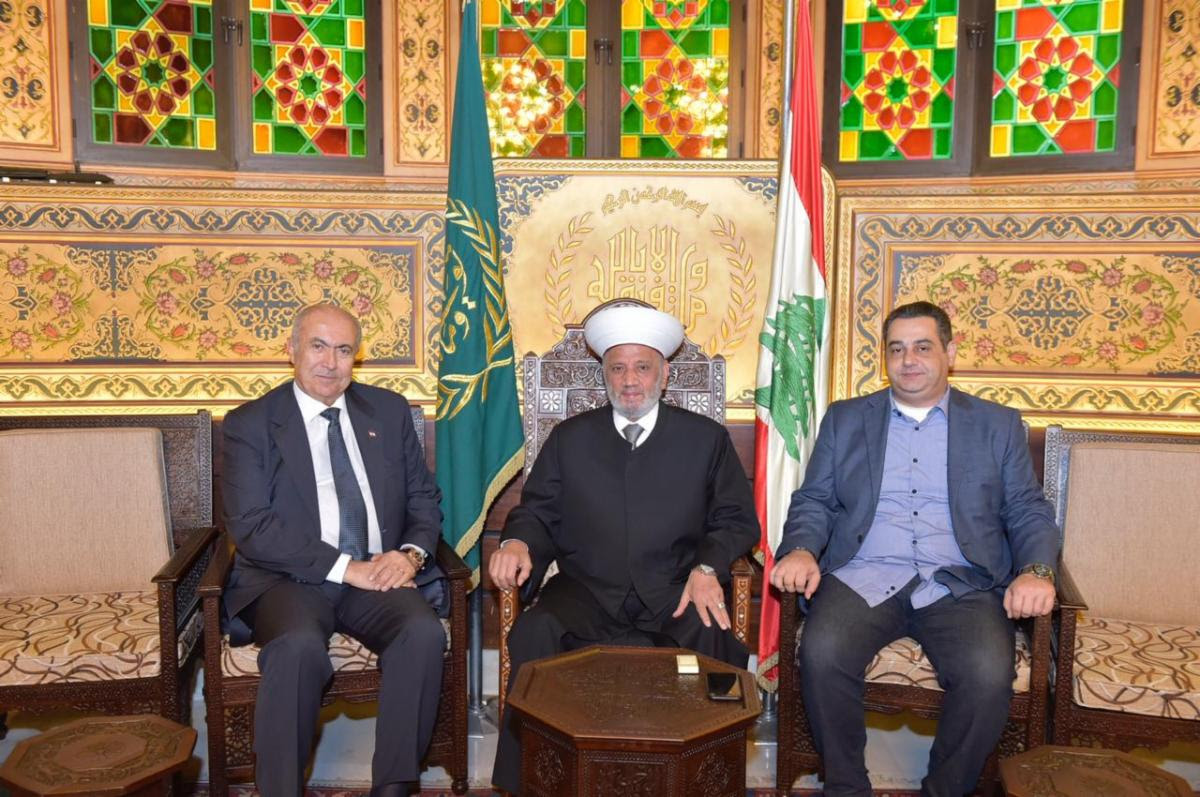
President of the National Dialogue Party, MP Fouad Makhzoumi, visited His Eminence Grand Mufti of the Republic Sheikh Abdul Latif Derian at Dar al-Fatwa, accompanied by Political Bureau member Mr. Samer Al-Safah. They discussed matters concerning Dar al-Fatwa and the general situation in the country amid the sweeping popular uprising against corruption and a political class that continues to disregard the public and its demands.
Following the meeting, Makhzoumi said that what was taking place in the squares represented a golden opportunity that the Lebanese had awaited for nearly 100 years: an opportunity to build a new Lebanon as the country enters its second centenary next year. He noted that the demands of the protest movement were legitimate and that people were asking for nothing more than the right to live with dignity, access essential services, and ensure that young people would not be forced to emigrate from their country. He stressed that these demands were entirely Lebanese in nature.
Makhzoumi praised the position taken by His Eminence the Grand Mufti and the Supreme Islamic Sharia Council, which affirmed their support for the people and the rights they were demanding. He said this position also reaffirmed the fundamental principles of the Taif Agreement and the need to expedite the call for binding parliamentary consultations, particularly given Lebanon’s difficult economic situation.
He emphasized that Dar al-Fatwa would always remain an institution that brings Lebanese together in general, and the Sunni community in particular, while safeguarding national unity and civil peace. He noted that this had been its role since Sheikh Derian was elected Grand Mufti of the Republic, stressing that Dar al-Fatwa would not take sides in any political battle.
Makhzoumi added: “We also discussed the economic and financial situations amid the crisis we are currently experiencing.” He pointed out that banks’ practices constituted a clear violation of the Code of Money and Credit. He questioned whether banks were genuinely experiencing a shortage of liquidity or whether their practices were an attempt to manage the crisis. He stressed that the way banks were treating citizens was wrong, as they had no right to prevent people from accessing or using their deposits and savings.
He noted that citizens’ purchasing power had declined because of the existence of two exchange rates for the US dollar: an official rate and an unofficial one. He attributed this situation to mismanagement of the banking and monetary systems, as well as the partnership between the banking sector and politicians. He stressed that remaining silent about this situation was unacceptable, as it was neither fair nor justified.
Makhzoumi emphasized that forming a government had become an urgent necessity, particularly because the financial situation could not afford the luxury of further delays. He expressed satisfaction with the emergence of several names being proposed for the premiership, noting that the Sunni community was not lacking in leadership or wise and capable figures. He hoped that the individuals whose names were being discussed would not be politically undermined, as they played positive and constructive roles in their communities and did not deserve to be treated in this manner.
He stressed that the priority was to work together in the interests of Lebanon and the Lebanese people and to cooperate in forming a rescue government of specialists capable of pulling the country out of its crises. He also expressed hope that politicians who had been in power since 1992 would listen to the people’s demands.
In response to a question about the timing of the binding parliamentary consultations and whether he had been contacted in this regard, particularly given that his name had been mentioned as a possible candidate for prime minister, Makhzoumi said that the country needed to move beyond the issue of names being proposed to head a government whose formation date was not even known. He noted that the caretaker government was not fulfilling its role as it should, adding that it made no sense to become preoccupied with names. He expressed the view that the consultations were unlikely to take place soon.
He also referred to international meetings scheduled for the following week, in addition to a Security Council meeting on Resolution 1701. He said the outcomes of these meetings and the support they would provide to Lebanon were extremely important, particularly if they included a condition requiring the swift initiation of parliamentary consultations, as this could encourage the process to move forward quickly and help the country move beyond speculation over candidates.
He concluded by saying: “Lebanon belongs to all of us, and we must work in the best interests of this country.”